
Charges Dropped Against CSUN Student for Skateboarding Ignite New Push for Non-Police Conflict Resolution Pathways
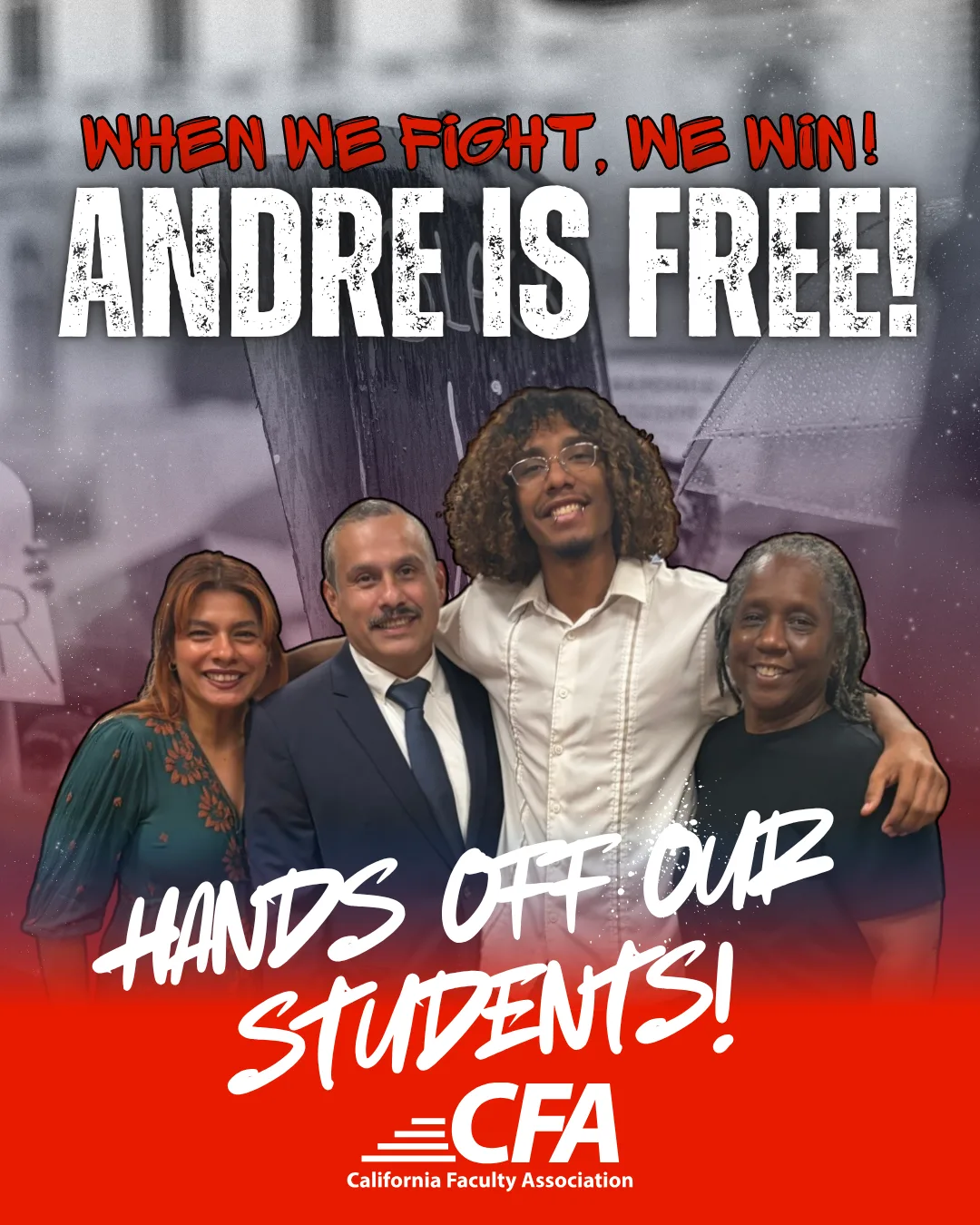
A judge last week dropped all charges against CSU Northridge (CSUN) student Andre Harris, who—after a skateboarding incident—was arrested in February 2026 for felony charges, including assaulting a campus police officer. What began as a harrowing experience for Harris has helped create a new pathway for resolving conflicts on campus without sending students through the criminal justice system.
Immediately after his arrest, Del Williams, CFA Bargaining Team member and CSU Northridge librarian, formed the Hands Off Students (HOS) coalition and began organizing actions on campus.
Williams, who continues to address the inequities and underrepresentation of Black faculty, staff, students, was concerned about ongoing police actions against Black and Brown students. Of the six most recent arrests on her campus, three involved Black students, who only account for 5% of the student body.
In April 2026, HOS wrote an open letter to CSUN President Erika Beck, asking her to intervene and address the over-surveillance and criminalization of students. Beck ignored the letter, declined to meet with the coalition, and has yet to address the arrests on her campus.
With the goal of keeping pressure on CSU administration to find a resolution before students went back to court, HOS continued to hold actions disrupting campus activities throughout the Spring semester. They also held a town hall where those affected by what was happening could share their experiences. During a separate faculty award ceremony, a faculty member questioned President Beck’s complicity in the matter.
But with no response from Beck, HOS turned its attention to CSUN’s Department of Police Services (DPS) Chief of Police, Alfredo Fernandez.
Spurred by an open letter to the Chancellor’s Office and growing pressure from the CSUN community, Fernandez began talking to the city and district attorneys about how cases involving students could be resolved through the university rather than the criminal justice system, even after criminal charges had already been filed.
When Harris appeared in court in July, Fernandez wrote him a letter of support and noted that he was working with the city and district attorneys to figure out how to handle the matter on campus. The judge granted their request and issued a follow-up hearing in two months to review their progress.
Over the summer, Harris and his mother met with Williams, Fernandez, the DPS director of DEI Outreach, Tony Arias, and the Dean of Student Affairs, William Watkins, to talk the issue through. The goal was to find solutions to shift away from criminal charges toward a change that all parties envisioned.
For some time, DPS had grown weary of skateboarders on campus. They argued that the skateboarders, including Harris, were gathering in areas that interfered with other campus activities.
But after these conversations, DPS began working alongside Harris to figure out solutions to help understand and identify the needs of these students. They even reached out to CSUN’s Physical Plant Management to discuss adding cement and removing tables from one part of campus to accommodate the skateboarders.
When Harris returned to court on September 17, faculty, administrators, and Harris had been working together to address the issues on campus. And it was working. Arias also wrote a personal letter of support, and Watkins promised Harris that he would help Harris continue his education this fall despite the challenges he had faced.
Witnessing the incredible progress, the judge dismissed the case.
In a historic feat, Harris’ case is the first of its kind in which a felony case was moved back onto campus to have an underlying issue resolved rather than having to go through the criminal justice system. Williams noted that this was the first time the city and district attorneys had experienced a progressive approach like this, and it has become an opportunity to rethink how the university can respond when student conflicts arise.
For Harris, the outcome is a big win, and his ability to continue his education is a major success.
But unlike Harris, the five other students charged prior to Harris were not afforded the same opportunity and ultimately accepted plea deals. In one student’s case, the resulting felony ultimately ended their pursuit in becoming a nurse. Many of the other students, including their families, were so overwhelmed by the stress and grief they felt. The students also spoke about withdrawing from the university altogether.
Williams, along with HOS, continues to meet with Fernandez, and the coalition keeps on bringing new people into the effort to rise up and protect our students.
“The major win is getting this transformative policy that allows pre- and post-charges to be brought back to campus to be resolved,” said Williams. “What this has taught us is this can also happen at other CSU’s where students don’t have to go through the criminal justice system.”
We would like to take a moment to thank Del Williams, along with Antonio Gallo, CFA Bargaining Team member and CSU Northridge lecturer, who legally represented Harris as well as other students pro bono. Also, thank you to everyone in the Hands Off Students Coalition for fighting to protect our students, and for having created an impactful model that other campuses can adapt to help students stay in school and address conflicts within their campus communities.
Join California Faculty Association
Join thousands of instructional faculty, librarians, counselors, and coaches to protect academic freedom, faculty rights, safe workplaces, higher education, student learning, and fight for racial and social justice.