
A Story About Resilience, Justice, and Never Leaving Family Behind
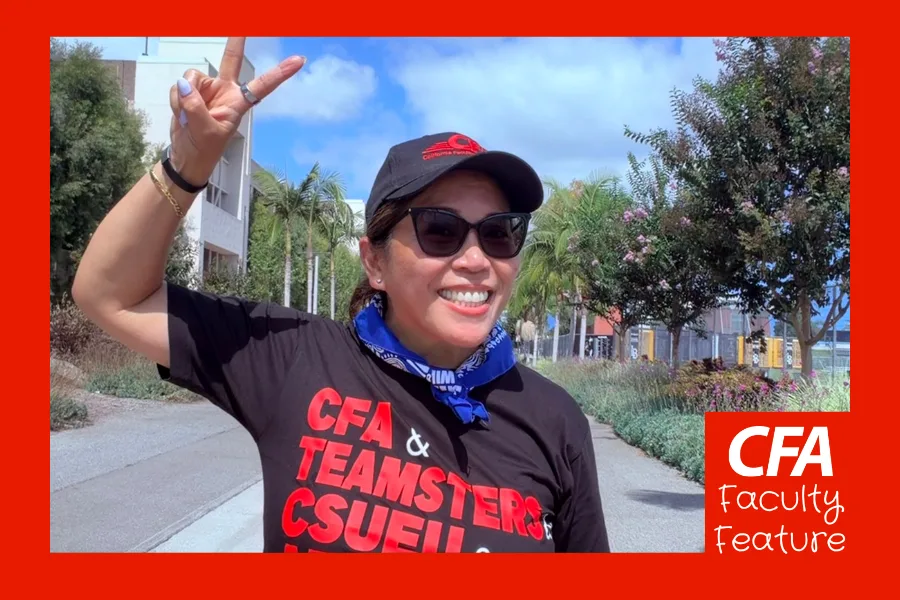
“Filipino American History Month gives me an opportunity to pause, reflect, recognize, and to be grateful for the sacrifices that those before us made, and also tell the stories of people like my grandmother who no one knows about, how many lives she saved in her province,” said Claire Garrido-Ortega, CFA Long Beach co-President, CFA Bargaining Team member, and Health Science lecturer. “It gives me an opportunity to look back and do my best to bring people together and never leave people behind.”
These values have guided how Garrido-Ortega moves through the world. Over the last three years, Garrido-Ortega has served as her father’s caretaker while navigating her own personal health concerns. In addition, she has been dealing with the weight of an autoimmune disease she passed down to her daughter, which has significantly impacted her daughter’s vision and threatens her sight. More recently, her sister began dialysis treatment, leading to further caregiving demands. These challenging circumstances have led to Garrido-Ortega’s decision to step away from an official capacity with CFA at the end of the academic year.
“In Filipino culture, there’s a strong emphasis on taking care of family, and I have a hard time turning my back on family when they’re in need,” said Garrido-Ortega.
Born in Hollywood, Garrido-Ortega’s parents divorced when she was in first grade, and she was subsequently raised by her mother. As her mother worked to make ends meet, they moved around frequently, and Garrido-Ortega attended eight different elementary schools.
At 15 years old, Garrido-Ortega had reached a breaking point. She told her father that she was planning to run away and disappear unless he came to pick her up. Although he did come for her, she soon made the decision to drop out of high school and move out on her own.
These life experiences would ultimately serve as a reminder for Garrido-Ortega that she had overcome difficulty long before she reached adulthood. “When things get tough, I remember I’ve been through tougher as a kid being on my own,” she said. “I survived that; I know I will survive this.”
Education as Transformation
For several years, Garrido-Ortega worked any job she could find just to survive. Those jobs were often labor-intensive work, such as cleaning carpets and cars, painting homes, and trimming yards. Eventually, she knew something had to change. She decided then that she would go back to adult school and get her diploma. This decision would ultimately change her life.
She found a genuine love for learning. After earning her GED, she enrolled at West Los Angeles College (WLAC), where even more opportunities began to appear.
While there, she began working as a Career Guidance Counselor Assistant and quickly learned how to navigate the transfer process and pursue advanced degrees.
Those years also helped shape her commitment to advocacy for students. Fortuitously, during a WLAC student government trip to Washington, D.C., she would come to meet her husband—a fellow WLAC student at the time—whom she says has been her biggest advocate through her struggles.
“Looking back, I realized we were both advocates for so many things, and we were both trying to change the system for the better,” Garrido-Ortega said. “Now here I am in CFA trying to make the CSU better for faculty. It feels like I’ve come full circle.”
While Garrido-Ortega initially transferred to CSU Los Angeles, she soon realized it wasn’t the right environment for her. She made the decision to transfer a second time to CSU Long Beach (CSULB), where she was a student when she gave birth to her daughter.
Determined to complete their education, Garrido-Ortega and her husband would take turns caring for their daughter so that the other could attend classes. By sharing their parenting responsibilities, both of them were able to earn their degrees.
Inheriting Her Grandmother’s Resilience and Compassion
Garrido-Ortega’s desire for change is strongly tied to her paternal grandmother, who was the only person consistent in her life and helped provide stability.
Even though her grandmother never had any formal education, she strongly advocated for Garrido-Ortega’s education and emphasized the importance of never leaving anyone behind.
This lesson was shaped by her grandmother’s tragic yet extraordinary experiences. During the Bataan Death March in the Philippines, her grandmother kept her family alive, including Garrido-Ortega’s father—who was only one year old at the time, by negotiating with Japanese soldiers. In exchange for preparing meals for the soldiers, her grandmother was able to prevent her family from being murdered or dying from starvation.
Her grandmother’s story offered Garrido-Ortega an example of what it means to care for others in even the most harrowing circumstances. It also helped her understand so many of the sacrifices that go unrecognized in our family histories or our communities.
“She was an amazing person, and she always spoke up about any injustices that were going on,” said Garrido-Ortega about her grandmother. “I really took a lot of that from her and challenged injustices happening on my own campus.”
Discovering the Power of Organizing
Her grandmother’s resilience served as a catalyst for Garrido-Ortega’s advocacy work. And although she has served in CFA leadership for 14 years, her first real interaction with CFA began when she encountered a work violation.
At that time, former CSULB president Jane Conoley had asked Garrido-Ortega and her colleague—two public health experts—to help transform the campus into a smoke, vapor, and tobacco free campus. Having initially agreed, the CFA chapter president intervened after realizing that management wasn’t expecting to pay them to lead a task force of 30 people to develop major policy changes on campus.
“That was very powerful for me to see!” Garrido-Ortega said. “I learned that we have a Collective Bargaining Agreement and that management can’t just ask lecturers to do work without paying them. I saw the advocacy behind that, and I saw what power looked like.”
That experience stayed with her. Since then—and in line with her grandmother’s lessons about speaking out against injustice–Garrido-Ortega has strongly advocated for other faculty who have been taken advantage of.
Her commitment to this work pulled her into years of CFA roles. She began as a department representative before becoming an Assembly Delegate. She later served as the Council for Racial & Social Justice representative, then became chair of the Membership & Organizing Committee. She then went on to become CFA Long Beach’s Vice President and is now completing her second term as Co-President as well as a Bargaining Team member.
“It’s great to be in these different positions, because it helps you understand the roles and expectations, but also have a wider perspective and approach issues from multiple angles,” she said.
Coming Full Circle from Student to Educator
Even when pursuing her degrees, Garrido-Ortega was struggling financially and relied on public assistance. Without a car, she spent two hours each way on public transit to get to and from classes. Education really opened the doors for Garrido-Ortega.
But school was too valuable for her to miss, and she knew that education was going to open doors for her. Having recognized her grit, one of her professors offered her the opportunity to guest lecture. From there, her natural ability to teach and connect with students led to a position to teach in CSULB’s Women’s, Gender & Sexuality Studies Department, where she spent the next 10 years. When a full-time lecturer position opened in the Health Science Department, she welcomed it, knowing that her passion for teaching and her interest in public health had finally collided.
For Garrido-Ortega, the field of public health has made all the difference in her life. During her third pregnancy, she was required to spend significant time resting in bed to avoid losing her pregnancy. Having already experienced two losses, she was determined to protect her third pregnancy.
At that time, she encountered a nurse who was deeply caring and attentive to Garrido-Ortega’s needs and left her with a very good impression. When Garrido-Ortega asked the nurse what she did, the nurse responded: public health. Immediately after giving birth her daughter, she returned to CSULB and changed her major to Public Health, not knowing that years later she would build a career as a faculty member in the Health Science Department where she was an alum.
“When things get tough, especially with education and public health being under attack by the current administration, you have to stay true to your heart and know that this is what you want to do,” Garrido-Ortega said. “You want to create change in the world, improve the lives of other people, especially those in marginalized communities. I can teach about theories and concepts in my field, but it’s my experiences that help take it to another level for the students, because some of them are going through those exact things I share with them.”
Her commitment to her students and her demand for justice is also what led her feeling so strongly about the recent death of Nolan Wells, a Black and Filipino American college student, that has been overlooked.
“He is part of our community, and there has been a lot of silence from the Filipino community,” said Garrido-Ortega. “I want to amplify his name in this moment, because Black Lives Matter.”
As Garrido-Ortega gets set to wrap up her formal years with CFA and spend more time with her family, she reflects on how much she has gone through and has had to overcome. No matter what, she knows she will always make it through.
“When things get really tough, I remember that I’ve been through tougher as a kid being on my own,” she said. “I survived that, so I know I’m going to survive this.”
Join California Faculty Association
Join thousands of instructional faculty, librarians, counselors, and coaches to protect academic freedom, faculty rights, safe workplaces, higher education, student learning, and fight for racial and social justice.