
The CSU's Broken Promises and A Faculty's Struggle to Survive
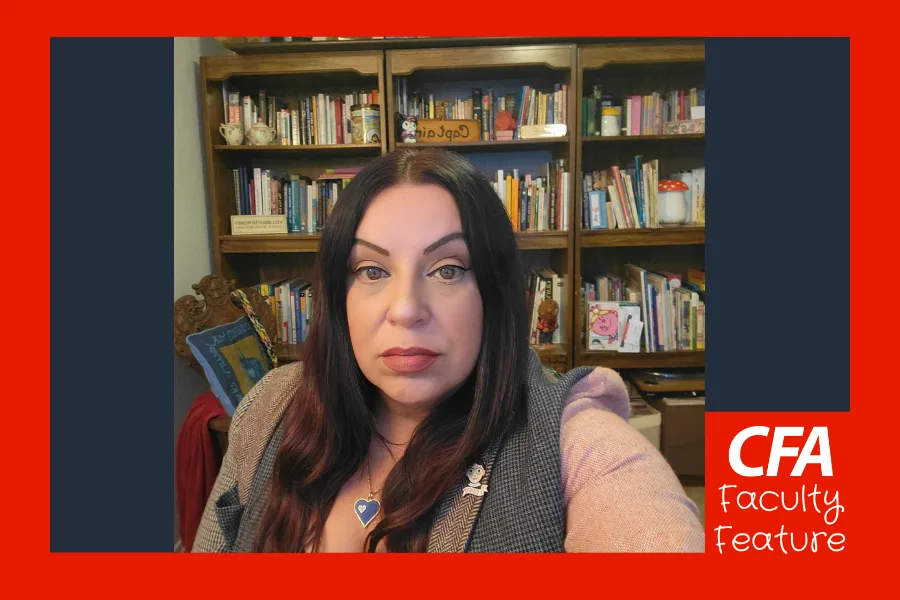
“I am the face of the CSU promise, right?” said Leyenda Jacobson, CFA Long Beach member and sociology lecturer. “The CSU said, ‘We are The People’s University. You come to us… tired, wretched, and poor, but if you bring your strengths with you and apply them, we will help you achieve the American dream.’ So, I made that bargain. Now, I have a job with the employer who made that promise to me, and they are breaking it. I have two degrees from the CSU, a BA and an MA, the highest degree the CSU awards. The CSU does not offer full-time tenured instructional positions for people with master’s degrees (which are technically ‘teaching degrees’). So, they’re devaluing the product they sell and the product they want me to sell to my students. When my students ask me what to do with a master’s degree, I say, I don’t know.”
A San Diego County native, Jacobson spent her twenties as a single mother on welfare. She lived in Section 8 housing, a federal program that helps low-income families afford safe housing, and she relied on financial aid throughout her college education.
“It was an era filled with all kinds of policies, potholes, and obstacles that made it difficult to go to college,” she said. “At that time, CalWORKs (California’s state welfare) did not view college attendance as an ‘authorized activity,’ so enrolling was an act of rebellion in itself.”
But it was also an era that helped her build incredible resiliency and grit. She learned how to navigate and survive poverty. “I eat trauma for breakfast,” she said, laughing, “and I have spent my life in the economic struggle. The CSU’s salary structure ensures I stay current in that field.”
After completing her undergraduate and graduate studies at CSU San Marcos (CSUSM), she was offered an opportunity to teach at CSU Long Beach (CSULB), where she has remained since 2014. For the last 12 years, she has commuted 150 miles roundtrip from Oceanside to Long Beach at least twice a week to teach her classes.
Unfortunately, what began as a hopeful career has become meaningful work in exchange for more poverty.
The Harsh Reality of Living in California
The cost of living in Orange County has accelerated so quickly after the pandemic that Jacobson’s wages haven’t been able to keep pace. She used to drive to Long Beach to attend professional development meetings and workshops to stay relevant in her field, but she can no longer afford to do so.
“Many people are taking on gig work to supplement their lecturer careers. It has become the norm,” she said. “Even still, we struggle with the inadequacy of our wages in the face of the ballooning cost of living.”
Jacobson, who had previously moved from Carlsbad to Oceanside because of gentrification, now found herself facing the same concerns in her new city. The old, rundown house that she used to rent for $1,875 has now doubled in cost.
“Late last year, I found myself in a precarious situation. I had run up my credit cards on basic living expenses and could no longer afford my rent. With an eviction notice over my head, I began to envision what it would be like to live in my car, while attempting to appear polished enough to represent the CSU as a faculty member,” she said. Jacobson explained that very few resources are available to people facing housing insecurity and homeless prevention services. In many cases, an individual needs to be unhoused to qualify for any aid. She began reaching out to general community resources but was met with confused responses at how a professor could be on the verge of homelessness.
Jacobson says that a big problem has been the lack of standardization for the financial metrics used by various organizations. Even though a single-person household earning less than $104,000 qualifies as low income in Orange County, her income was still too high to qualify for any sort of housing assistance programs.
“I felt guilty seeking support from the general community, during a time of severe economic inequality. I wrestled with the idea of even asking for support,” she said. “I make around $60,000 a year, which is not true of most people coming through the doors of homeless shelters.”
Fortunately, her 25-year-old daughter and her son-in-law made the decision to move back in with her to help her pay the rent.
“We live in this economy together and we’re supporting each other in the many ways that intergenerational Brown families do,” she said, reflecting her Filipino and Mexican ancestry. “But my white, professional side, is mortified. There is no excuse for a college professor to need to rely on her adult children to keep a roof over her head.”
Finding Alternative Living Solutions for Community Members
Along the way, Jacobson’s housing precarity led her to consider whether CSULB could establish a safe parking program on campus for faculty and staff like her.
With the effects of gentrification and a surge in unaffordable housing, many communities and municipalities have turned to creating safe parking programs. Jacobson pointed to Long Beach City College, which opened a safe parking program for students who may need to sleep in their cars. They can also access campus bathrooms and hygiene facilities.
Another safe parking program used to be housed in the parking lot of Oceanside’s North County LGBTQ Resource Center (but has since relocated), where they even provided security so that individuals sleeping in their cars could have peace and privacy.
“It could be a bit embarrassing to even ask, but why aren’t we opening up a program like this at CSULB to faculty and staff?” Jacobson wondered, admitting that it’s easier to talk about unhoused students than unhoused faculty or staff.
At the beginning of every semester, Jacobson also informs her students about the food pantry and other resources they can use to support themselves. She tries to de-stigmatize this by letting them know that she herself uses her community’s food pantry and other services provided for her. Still, she questioned why the food pantry on campus is reserved exclusively for students.
“All Basic Needs services should be open to all campus community members. There are people on campus whose paychecks are less or similar than mine who may be food insecure,” she said. “If I’m hungry, then they’re hungry.”
There should be no conflict between management and The People of the CSU when it comes to fully supporting its members. “At the end of the day, this is The People’s University and it’s The People’s money,” she asserted. “It’s not the Board of Trustees or the chancellor’s money. That lady gets a $96,000 housing stipend she doesn’t even need. The least she could do is waive her housing stipend to show some level of respect, but no.”
The Fight for a Better Contract and a Living Wage
Along with other CFA members, Jacobson is now pushing for a strong upcoming contract that will improve conditions for her and faculty across the CSU. She credits Dr. Sharon Elise, past CFA Associate Vice President, Racial & Social Justice, South, and CSUSM professor, with teaching her everything she knows about social movement and activism when she was both an undergraduate and graduate student of Elise.
“I’ve taken what I’ve learned from her, and I now use it to fight for the rights of my students and lecturer faculty,” she said. “I would not have the opportunity to use these skills, if not for the post-pandemic cost-of-living surge and my stagnant, deflated salary. My living conditions were untenable, and I couldn’t live like this anymore. Restructuring our union was the first phase; now it’s time to restore the CSU.”
Jacobson voted “yes” to authorize a strike, because her and her colleagues’ livelihoods depend on a good contract. For her, there’s nothing abstract about what’s at stake.
“It’s about our dignity,” she said. “You don’t need to be an economics or mathematics major to understand that I’m two-thirds of the way to poverty in Southern California.”
Jacobson stated how proud she is of the work she does in the CSU, but described the pay as shameful.
“Every day, I do my part to uphold the CSU promise for my student,” she said. “The best and brightest, we scouted from every corner of our state. Our chancellor once referred to what we do as ‘magic’, but it’s not. It’s research-based best practices and dedication to the dream. Me fighting to restore honor to the degrees I help them earn, and the subsequent occupations they will hold, is part of upholding that promise.”
“I’m ashamed of my wages and the need for my daughter to subsidize my housing, but that’s not my burden to carry,” she continued. “That’s the chancellor’s and the Board of Trustees’ burden. This is OUR money, so somebody’s got things twisted around here, and it needs to get fixed.”
Still, Jacobson remains hopeful that change is coming. “I will always have hope that speaking truth to power will be effective,“ she said. “But if we don’t force change now, the damage will be irreversible for many years to come. The writing’s on the wall. We need to have empathy for one another, and we always need to work together. The struggle will always continue, but together we overcome.”
Join California Faculty Association
Join thousands of instructional faculty, librarians, counselors, and coaches to protect academic freedom, faculty rights, safe workplaces, higher education, student learning, and fight for racial and social justice.