

One Librarian’s Commitment to Empower and Uplift CSU’s Black Community
In January 1969, nearly 300 students at San Fernando Valley State College (now CSU Northridge) were arrested after leading a series of civil rights protests to address the inequities and underrepresentation of Black students, faculty, and people of color on campus. These demonstrations became known as the “Storm at Valley State.”
A lot of good came out of the protests, including the creation of two of the nation’s oldest Ethnic Studies departments: Pan-African Studies and Chicano/a Studies.
But these wins came at a cost. San Fernando Valley State College became the first and only U.S. university to charge Black student activists with felonies during their struggle to demand educational justice, even though white students and other students of color also participated.
“So much was gained as a result of their activism,” said Del Williams, the Acquisitions Librarian at CSU Northridge (CSUN). “We now have an Africana Studies program and the Black House. The Educational Opportunity Program (EOP) was expanded, we’re building a Black Resource Center, and we have more Black faculty and staff than before. The university, however, never went back and apologized for how the students were treated.”
To honor their legacy, Williams has made it her mission before retirement to help expunge the criminal records of the 33 Black students who were charged during the protests. “It struck me that that generation didn’t get to vote for the first Black president of the United States. They didn’t have their civil rights,” she said.
This fight also hits close to home. Her daughter is currently the only Black student in CSUN’s master’s program in biology. Williams herself earned two bachelor’s degrees in Liberal Studies and Sociology from the same campus.
Williams’ approach to advocacy involves wearing many hats. She currently serves as CFA Northridge’s Council for Racial and Social Justice representative, her chapter’s Faculty Rights co-chair, and recently joined CFA’s Bargaining Team. In addition, she serves as the president of the campus’ Black Faculty and Staff Association (BFSA) and sits on the Black Student Success Council. Williams also plays a role on the Educational Equity Committee for CSUN’s Academic Senate and got involved with Project Rebound to learn more about how to erase criminal records.
“I use these positions to leverage getting into certain spaces where I could meet with people who I need to connect with. They get me meetings with the president, the provost, and others who can help advance what I am doing,” Williams said.
While the former CSUN president claimed the university could not expend any resources to help expunge the records, the current president, Erika Beck, decided it was a worthy cause. “She understood where I was coming from, and together we were able to get the first record expunged for Dr. William Burwell in 2024. It was done posthumously, but Burwell’s family was deeply appreciative. We want to see that done for all the others who still have criminal records,” Williams remarked.
Williams also sought help from CFA’s Council for Racial and Social Justice (CRSJ), whose members suggested publishing a letter in the media from BFSA thanking student activists at the Storm at Valley State for their sacrifices.
“We considered bringing back some of those students during Black History Month in 2018 to talk to current students about what they had gone through, but I realized that we have already asked them many times to come back and do something. It was time that we did something for them,” Williams said.
She wants to see more recognition of Black contributions to her university. “We have the murals in Jerome Richfield Hall, where the Chicano/a Studies Department can celebrate the Chicanx community. We have the Peace Poles in several different languages that international students did many years ago. And the latest is the Tataviam mural that was painted in the library in recognition of the people whose land the campus is on. Yet, there is no one place that you can go and see anything about the contributions that Black folks made at the Storm at Valley State.”
CSUN continues to have far fewer Black students and faculty than what is represented by the city’s demographics. While the city of Los Angeles has a Black population of 8.5%, Black students only make up 5% of the campus’ student body, and Black faculty comprise around 6.5% of campus’ faculty. Although there was a growth of Black students in the 2000s, that number gradually declined in the 2010s.
Williams drew parallels between Black student activists in 1969 and the issues that Black students continue to face year after year in trying to protect Ethnic Studies. “They had to protect the program every year until it finally became a state law to make it part of the curriculum. Now, they’re trying to protect it from budget cuts,” Williams said.
She also noted that retention was an issue, with many of her colleagues feeling isolated. She chose to rebuild BFSA because she wanted to help build a community where they could find each other. “I was seeing a lot of my Black colleagues come and go. They might be there for a year or two before they were gone,” Williams lamented. “We can’t retain them because of how they’re being treated. Right now, I’m the only Black librarian. At one point, there were four of us.”
Through conversations with her colleagues, Williams learned that many of her Black colleagues left because of the micro- and macro-aggressions they experienced around campus and in their departments and colleges. She realized they were still dealing with the same issues that Black students, faculty, and staff were facing in 1969.
To combat these issues, CSUN began organizing Black Excellence cohorts in Fall 2022 to help Black students transition to college. Here, Black students are placed into a group with a Black instructor to help them acclimate to the university. Another program, Black Scholars Matter, helps connect Black students to resources and enhances the experience of college-bound students as they move through their academic journey. “The idea is to increase the number of Black students on campus and improve their graduation rates,” Williams said.
She is asking that administrators hire at least one additional Black librarian in public services to meet the needs of these cohorts. “If we can uplift Black faculty and staff, we in turn uplift Black students. That will increase recruitment and graduation rates, and make everything else possible,” Williams said.
Between navigating the roles of being a parent to a CSU student, a librarian, and an activist, Williams still recognizes the importance of leisure, making time for conversation, and building relationships.
“BFSA members have been leading the conversation about our wellbeing, and what we’re doing to take care of ourselves,” she said. “A few times each month, BFSA members will get together as a group to walk and talk around campus. We don’t talk shop; we talk about everything else.”
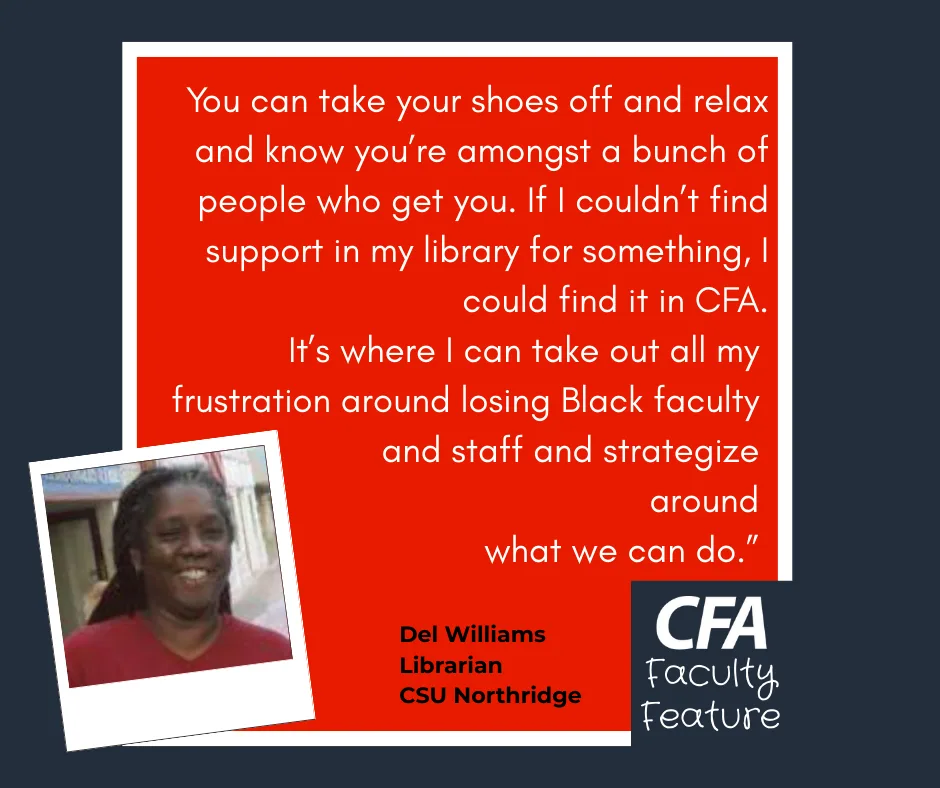
She feels most at home in CFA and BFSA. “You can take your shoes off and relax and know you’re amongst a bunch of people who get you,” she said contentedly. “If I couldn’t find support in my library for something, I could find it in CFA. It’s where I can take out all my frustration around losing Black faculty and staff and strategize around what we can do.”
Williams is continuing her efforts to build connections with other BFSA chapters across other campuses. She’s discovered that many of them are also involved with CFA, namely its Black Caucus. Her goal: to align BFSA’s goals with CFA’s work and build stronger bridges for collaboration.
Join California Faculty Association
Join thousands of instructional faculty, librarians, counselors, and coaches to protect academic freedom, faculty rights, safe workplaces, higher education, student learning, and fight for racial and social justice.