

One Librarian’s Fight for Safe Lactation Spaces and Parenting Faculty
“Having to find a bathroom to express milk is a stressful process to begin with, because you’re often leaving your infant somewhere else and trying to provide nourishment for them,” said Del Williams, a CFA Bargaining Team member and CSU Northridge (CSUN) librarian. “If there are other stressors, it becomes even harder to produce milk. Having to find the right bathroom that was quiet enough meant you couldn’t use the student bathrooms. I also couldn’t use the bathroom connected to my office because people are in and out all the time. So, one of the bathrooms I found was in the basement of the library.”
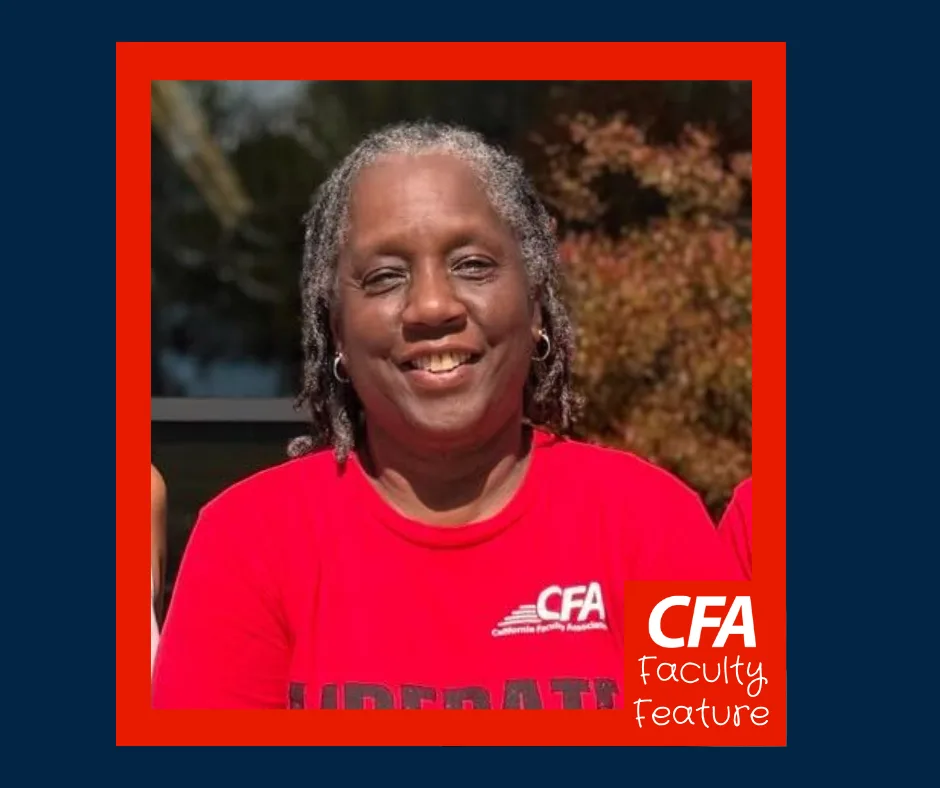
Williams was recently featured in our Headlines for her leadership and support for Black students, faculty, and staff at CSUN. In addition to that activism, her experience as a parent resonates deeply with many parenting faculty across our campuses. Her story highlights serious problems that many faculty, staff, and students face when lactation spaces are limited or inadequate.
Williams was a student at CSUN and graduated in 1988, but it wasn’t until she began working full-time at CSUN that she began experiencing heavy barriers as a mother, most notably with the lack of proper lactation rooms.
After the 1994 Northridge earthquake, construction issues required librarians and library resources to be moved into temporary facilities (i.e., trailers) set up in a campus parking lot. It was during this time that Williams had her first child. The full library building would not be reopened until 2000.
“It would be pouring rain, but our office was in a trailer separate from where the bathroom was located,” said Williams, expressing the challenges of having to move from one building to another. “I was nine months pregnant, waddling out from my office across a wet parking lot to get to another trailer.”
Even after Williams had moved into the main library, lactation spaces were still impossible to find. “It wasn’t even part of the conversation at that time,” said Williams.
Although the basement level of the library was quieter and did not hold any classrooms, Williams found that people in the basement would frequently crouch to look under the bathroom door, trying to see who was in there and why they were taking so long. On one occasion, someone went inside the bathroom to investigate, then left and returned with someone else.
“It was this whole situation,” Williams recalled, describing how she also had to anxiously pack everything up and rinse everything out in the bathroom sink. “There was no real space dedicated to what so many people go through. I’m not disturbing anyone, so why do people care? I just don’t want others to have to deal with that kind of discomfort and stress.”
While Williams noted that conditions have since improved and that there are more dedicated lactation rooms, the expectations for those spaces should be respected and available for the people who need them.
“Usually when we discuss the importance of lactation rooms, we don’t hear the details,” said Williams. “People don’t understand what others have to go through in order to produce milk.”
Williams takes pride in her library being one of the first buildings on campus to turn a room into a lactation space and voluntarily create a gender-neutral bathroom. Still, she recognizes that many lactation rooms do not include a sink, and expressing milk with a breast pump can get messy. “You need hot water to rinse everything out, but the majority of lactation spaces merely specify that there is running water nearby. That just means there is a bathroom down the hall somewhere or that your department has a kitchen.”
In 2024, CFA members won contract language that requires the CSU to provide adequate lactation spaces and restrooms on campus, and to ensure that their locations are publicized and available to be searched for online.
In our current round of bargaining negotiations, we continue to push for improved rights for parenting faculty, including a minimum of 80 days or one full semester of paid parental leave. When parents, especially women, do not receive adequate leave, it negatively affects their health, breastfeeding, and ability to bond with their child. It also places women at a much higher risk of slowing career advancement because of having to juggle their caregiving responsibilities with research and teaching.
Williams continues her fight on our Bargaining Team for improved accommodations for parents, drawing from her own experiences to understand what other parenting faculty have to go through when they don’t receive appropriate resources.
Her advocacy here is but one component of her broader vision to create a more just and inclusive environment in the CSU.
Join California Faculty Association
Join thousands of instructional faculty, librarians, counselors, and coaches to protect academic freedom, faculty rights, safe workplaces, higher education, student learning, and fight for racial and social justice.