
Why Academic Freedom Matters to All of Us
On November 21, our CFA Bargaining Team presented more than a dozen proposals to CSU management after two days of bargaining meetings at the Chancellor’s Office.
One of these proposals includes the addition of a new article concerning academic freedom. This is a freedom central to and inherently intertwined with democracy and lends itself to a more racially and socially just society.
Academic freedom isn’t simply for the sake of us being able to say, teach, or publish what we want. If the focus of education is relationship-building, then academic freedom is about our responsibility as educators to help cultivate the confidence, resilience, and problem-solving skills that students need to craft a truly democratic society.
But public higher education is in peril, from an authoritarian far-right government that wishes to defund public education to our own CSU leadership that has unjustly suppressed campus speech and retaliated against anyone—students, faculty, or staff—who wishes to challenge their prioritization of profit ahead of students.
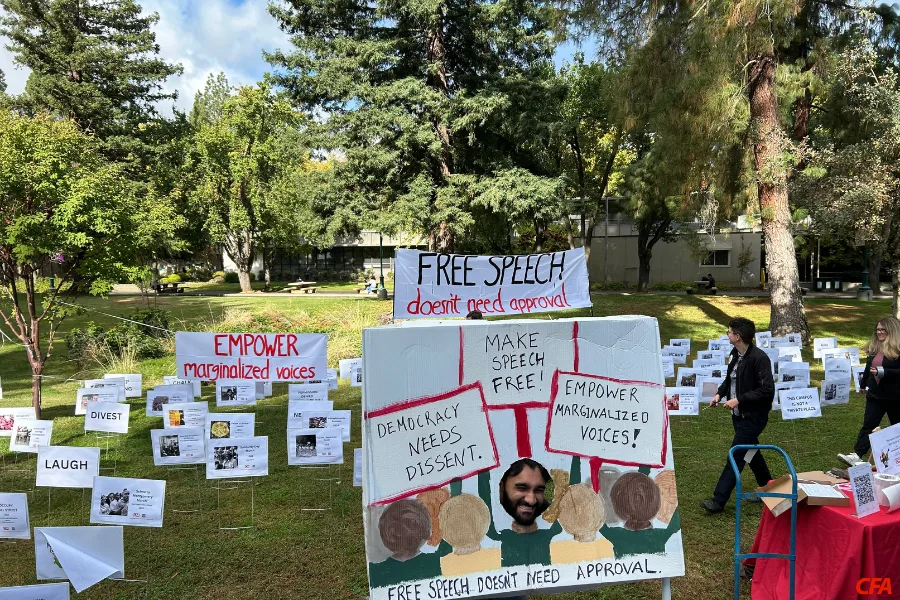
The Chancellor’s Office has now, more than ever, intensified its attacks on academic freedom as a means of suppressing lawful speech. In Fall 2024, the chancellor implemented a systemwide interim Time, Place, and Manner (TPM) policy that places enhanced restrictions on campus protests and demonstrations, while individual campuses prepared campus-specific addendums to the policy. While the policy is not in effect for faculty until our meet and confer process is complete, several students have already been hit with alleged policy violations.
The CSU administration amplified the climate of fear when they willingly shared CSU employees’ personal information with the Equal Employment Opportunity Commission (EEOC), after the federal agency issued a subpoena to CSU Los Angeles claiming it was investigating allegations of antisemitism. This was done without the knowledge of any faculty or staff member.
This affects all of us, not just some of us.
Across the country, many faculty like English professor Melissa McCoul at Texas A&M, part-time instructor Lisa Greenlee at Guilford Technical Community College, adjunct professor Kenneth Howell at the University of Illinois at Urbana-Champaign, associate professor Maura Finkelstein at Muhlenberg College, and Jessica Adams at Indiana University have all been fired or faced disciplinary action relating to academic freedom.
At the CSU, Dr. Sang Kil was “temporarily” suspended with pay in May 2024. Kil received a letter announcing that she was being investigated for violating university policies repeatedly during on-campus pro-Palestinian protests and encouraged students to do the same. Kil denied these accusations, claiming they were attempts to suppress academic freedom and protest-related speech.
More than a year later, on June 12, 2025, San Jose State administrators notified Kil that she would be terminated from her faculty position because of her alleged violations during two protests and an encampment in 2024.
After an eight-hour statutory dismissal public hearing on October 24 regarding Kil’s termination, the Faculty Hearing Committee concluded that Kil should not receive any of the three possible disciplinary sanctions she was given. They argued that she has already endured significant negative consequences and has been unable to perform the duties for which she had been hired during her suspension.
On November 21, San Jose State President Cynthia Teniente-Matson overturned the Faculty Hearing Committee’s unanimous decision that asserted she did not violate one of the rules cited in her termination notice and that the termination was not appropriate. CFA processed Kil’s request for arbitration immediately after President Teniente-Matson’s decision. Regardless, the president’s action sends a chilling message to all faculty that perpetuates what is happening nationwide.
“I expected and am disappointed with the SJSU president overturning their recommendations. This shows that this is not only an attack on our free speech and tenure system, but also an attack on faculty rights of co-governance,” said Kil. “However, I was satisfied to see the faculty hearing panel cited Hillel of Silicon Valley as pressuring and directing the president and provost to go after me, open an investigation on me, and determine what charges to impose. This shows what AAUP (American Association of University Professors) warned was ‘New McCarthyism,’ where outside groups, external to the university, are directing campus administrators to target faculty for their political views and speech.”
Whether one agrees with Kil’s decision to speak out against what she perceives as injustices is not the issue. The issue is that she was silenced for doing so.
This kind of repression is not an isolated incident, nor is it limited to higher education.
Over the past several months, CFA members actively resisted the passing of Assembly Bill 715, because it threatens K–12 teachers’ curriculum and ability to engage students freely. The bill enables public surveillance and censorship of a teacher’s attitudes and their work. While it targets elementary and high schools specifically, its implications for higher education are concerning.
The recent federal Public Service Loan Forgiveness “final rule” excludes eligibility for those the rule characterizes as supporting “illegal” activities. Essentially, the Trump administration is targeting organizations, advocacy groups, and institutions that support immigrant rights, women’s rights, LGBTQIA+ issues, and, more broadly speaking, racial and social justice efforts. And despite the chancellor’s rhetoric of inclusivity, she has demonstrated apathy toward her stakeholders and uncritical compliance with the will of the federal government.
All of this reflects a broader attack on educators and students. We need to push back collectively, taking a stance together as a whole union but also within our local chapters. We must hold our chancellor and our presidents accountable for their repression of academic freedom. They need to understand that the fear and chilling effect they’ve imposed on faculty to silence them is unacceptable and deeply troubling.
Our proposed article on academic freedom wishes to see an end to any sort of retaliation or censoring for when a faculty member exercises their freedom or rights, whether this is through performing university duties or in engaging in expressions outside the university. We should have the right to determine pedagogy that we believe best engages our students, and we should certainly be allowed to engage in controversial topics.
Academic freedom is at the heart of our fight for justice—not just as a means of protecting our places of work, but as a means of fighting for a nation and a world that welcomes and encourages safe places for our diverse communities to exist.
Join California Faculty Association
Join thousands of instructional faculty, librarians, counselors, and coaches to protect academic freedom, faculty rights, safe workplaces, higher education, student learning, and fight for racial and social justice.