
Faculty Feature: The Power and Strength That Comes With Community-Building
“CFA really helped build my confidence,” said Dr. Monique Turner, CFA Dominguez Hills Council for Racial and Social Justice co-chair and CSU Dominguez Hills (CSUDH) lecturer. “Being able to advocate for my students and peers at an institutional level is something I’ve learned through our union. Most importantly, I’m not alone. Faculty across the state are doing this work together.”
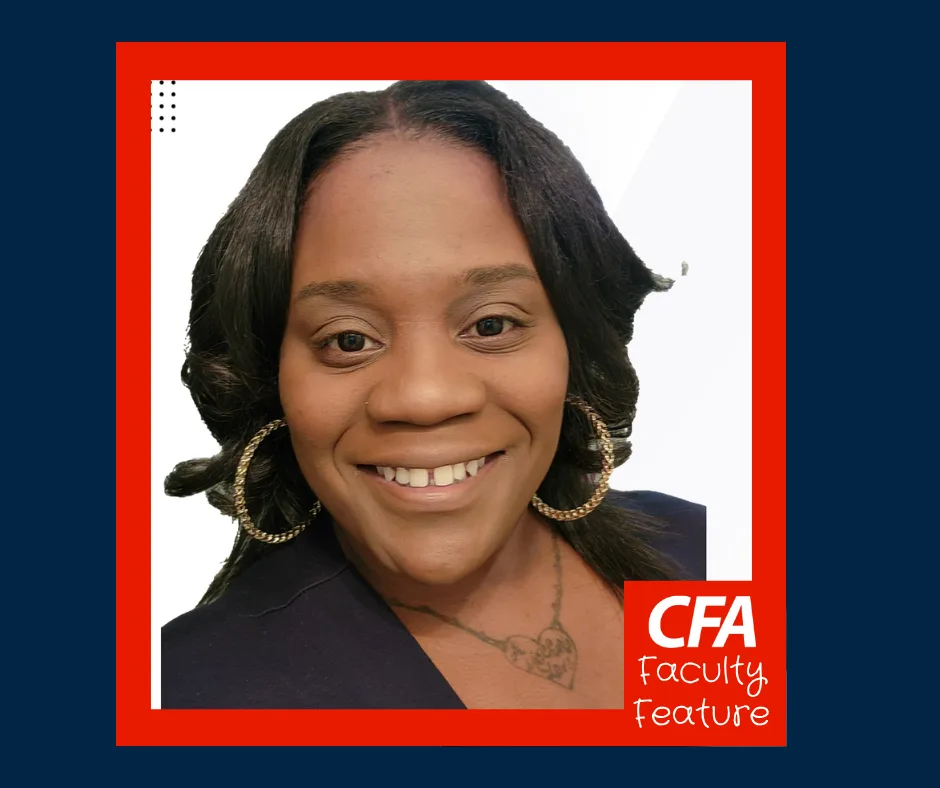
A proud alum of CSUDH, Turner earned both her bachelor’s and master’s degree there and has now spent almost a decade teaching in the university’s Psychology Department.
Her journey to teaching was shaped by watching her grandmother teach special education children. But it was an undergraduate statistics course with Dr. Carl Sneed, the current chair of her department, that solidified her desire to teach. She discovered a fascination for manipulating numbers but also found a clearer sense of herself as an academic. “I realized I could become a professor and help others,” Turner said.
Her desire to help ultimately led to her pursuing clinical psychology. She gravitated toward the study of cognitive and executive processes. She wanted to understand the human experience and how people can learn to heal from challenging experiences. More importantly, she wanted to help individuals, including herself, better understand and help build stronger connections with one another.
Her research addresses educational inequities within academic systems. In her dissertation, she examined how stereotypes impact and threaten the academic performances of minority students, particularly in regard to their nationality, race, or ethnicity. To counter these concerns, she would intervene with positive psychology interventions, including exposing students to positive role models to mitigate the negative consequences of stereotypes.
“We have to change how we think about ourselves through positive affirmations and statements,” said Turner. “By reframing our thought processes, we can tackle stereotypes and racism at an individual level. When we are exposed to positive role models, it not only impacts the individual, but also the group dynamic as well.”
In the classroom, Turner notices both challenges and rewards. While some students struggle with basic skills involved in reading and grasping concepts, she finds joy in watching her students grow in confidence throughout the semester. She encourages and discovers ways to help students use abstract reasoning and critically thinking when engaging with the course material.
“When students begin to think critically, they begin to see its benefits,” said Turner. “That sort of engagement creates opportunities and provides spaces where that can happen.”
However, Turner underscores the importance of evolving pedagogy. She is constantly learning and taking constructive feedback from her students into consideration, especially when it comes to fostering a neuro-affirming environment. She has her students visually map out their thought processes so that she can adapt her teaching to support them and unlock new methods of discourse that will help students retain information more effectively.
Turner also teaches positive psychology and emphasizes the significance of the CSU as an enabling institution. “Much like nonprofit organizations, the CSU has a mission statement and a purpose, both of which are intended for the public good and should help the populations they serve,” she said. “If they are failing to abide by both, then they’re not helping the students.”
This is why Turner integrates discussions of social justice into her classroom, including updates on issues affecting faculty and staff. She also starts off every course by establishing that her class is an open and brave space for anyone to talk about personal, cultural, or economic concerns.
Her commitment to community-building is also mirrored in CFA.
“It’s really motivating to see how CFA brings us together and creates a sense of community,” she said. “Our members have highlighted that experience for me and other women and people who identify as persons of color… to know that we are supported, that we have rights, and that we have a voice.”
Through Turner’s involvement with CFA, she believes she has honed her ability to speak more confidently in political and social conversations, including in interviews or when engaging with public officials.
“Sometimes, we can hold dogmatic opinions on ongoing issues,” Turner noted, “and there can be less of a willingness to want to take in other perspectives. But maybe with new members, we can bring in new perspectives that can help us grow, even if it’s difficult to hear.”
Mentorship has been central to Turner’s work. She actively connects faculty and alumni with students, hoping to help develop their professional and academic lives. She played a key role in a project called “It Takes a Village,” which was created in response to the murder of George Floyd in 2020. It helped provide “brave spaces” within academia for courageous conversations to happen. During her time as the Non-Tenured Track Faculty Representative for her campus’ Academic Senate from 2020-23, she advocated for these conversations between students, faculty, and staff.
“That’s also part of what I try to bring to CFA,” Turner stated. “We can disagree in effective ways where we’re listening, we’re validating, but we’re also moving forward.”
Turner is also one of the co-directors of the Positive Psychology Lab, which was designed to encourage the personal and professional growth and development of all its members.
Turner has since created a student club called “The Village,” and continues her efforts to build community and further connections on campus.
Stopping to reflect on her own experiences, Turner spoke honestly about some of the hardships faced by women and people of color in academia.
“Sometimes there’s more that we have to do to prove ourselves,” she said. “It may not be fair, but we need to consider what those differences are and how we can be better.”
While she feels strongly supported by her department, she is an advocate for clearer pathways for lecturers to become tenure-line faculty. She emphasized the importance of retaining faculty who are ethnic minorities, not only for the purpose of equity in hiring, but because it is valuable for the success and representation of students who are also ethnic minorities.
“We can always be more inclusive and keep equity in every part of the decisions we make,” said Turner.
Join California Faculty Association
Join thousands of instructional faculty, librarians, counselors, and coaches to protect academic freedom, faculty rights, safe workplaces, higher education, student learning, and fight for racial and social justice.