
“Fight for Five” Anniversary: Our Fight Continues a Decade Later
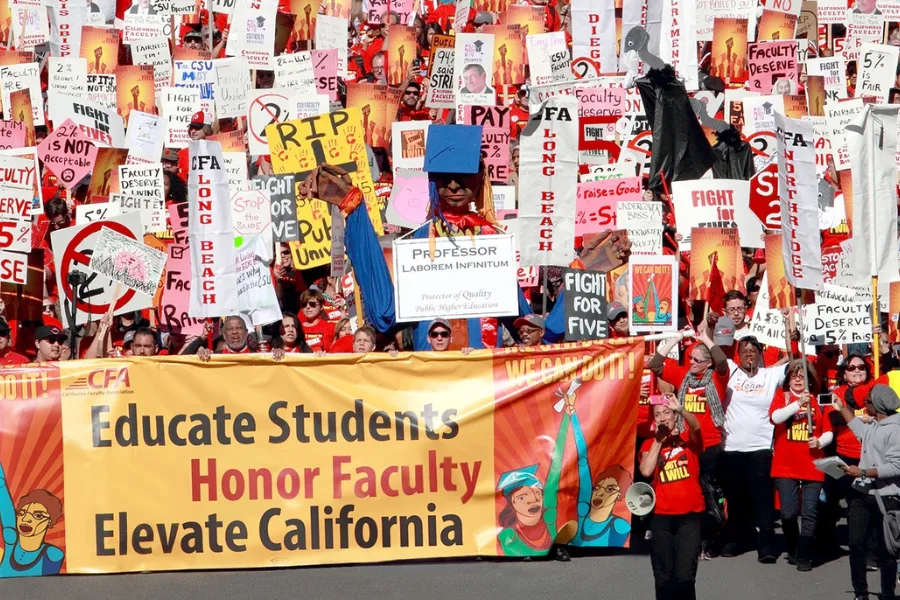
Ten years have passed since CFA’s “Fight for Five” contract campaign. It was a moment where faculty and communities from across California demonstrated what collective action could achieve. All of us fought hard together and won a substantial 10.5% General Salary Increase (GSI) for CSU faculty in 2016 and 2017.
The campaign garnered significant support from legislators and local communities, and it brought long-standing inequities in CSU compensation between faculty and CSU executives into public view.
While faculty were struggling to make ends meet, management prioritized the CSU’s money elsewhere. In 2004 to 2014, we saw an increase of 48% in expenditures on managers, despite the CSU net operating budget growing by only 33%. In contrast, expenditures on faculty salaries only grew by 25%. Over that decade, the number of managers also increased by 19.2% while the number of tenure-line faculty fell by 3%.
Growing concerns about spending became more apparent when wasteful supplemental compensation was given to presidents. In 2011, Jeffrey Armstrong, Cal Poly San Luis Obispo president, was given $19,179 to relocate his home and $30,447 for fees and other expenses associated with selling his home. Armstrong, who received an additional $100,000 annually following the CSU Board of Trustees vote in November 2025, now makes $611,203 in base pay alone. That number could be supplemented with another 15% ($91,680) after his next performance review.
Against the backdrop of these exorbitant payouts to the top 1% of CSU employees, the then-CSU Chancellor Timothy White refused to offer faculty anything more than a 2% raise during collective bargaining. For faculty earning $40,000, a 2% raise would equate to a measly $800 that would hardly offset surging prices in housing, food, utilities, transportation, and healthcare.
Enough was enough. 94% of voting CFA members supported authorizing strike actions from April 13 through April 19.
“Faculty were ready to strike,” recalled Michelle Ramos Pellicia, CFA Vice President and CSU San Marcos professor. “We were outraged at management stonewalling what everyone else knew was just and fair. But, it might have been for the best. Faculty, students, staff, community members, as well as legislators turned out in droves at our rallies across California and at the state capitol in April 2016 to demand fair compensation. The CSU was alive and our message of injustice was amplified around the state! We were organized, we were angry, and we won.”
Just one week before the planned strike, management agreed to resume negotiations. Both CFA and management came away from the talks announcing a tentative agreement, which included a 5% GSI on June 30, 2016, a 2% GSI on July 1, 2016, and a 3.5% GSI on July 1, 2017. In addition, eligible faculty would also receive a 2.65% Service Salary Increase (SSI) during the Fiscal Year 2017-18 effective on the faculty’s anniversary date. Finally, the minimum increase on promotion would also be increased from 7.5% to 9% effective July 1, 2016.
97% of voting CFA members strongly supported ratifying the tentative agreement.
“I was a union member but never active until our Fight for Five,” said Vang Vang, CFA Treasurer and Fresno State librarian. “Knowing that our union siblings were there with us, and students and their parents were kept informed about our ongoing struggles to buy groceries, pay bills, and support our families, made me pick up that pen to make that sign and write my name on the picket line form. More than 3,200 delegates from the California Democratic Party voted to endorse our campaign. What made me stay active since our Fight for Five was not only were we very much in the right, but we were also together.”
Then, more recently, in 2024, CFA members secured further economic gains after two separate strike actions in December 2023 and January 2024. We won a 5% GSI for all faculty retroactive to July 1, 2023, as well as a 5% GSI on July 1, 2024 and a 2.65% SSI for the 2024-25 academic year for all eligible faculty. In addition, we raised the floor for the lowest-paid faculty in salary Range A by $6,000 and Range B by $3,000.
But CFA members also recognize that fair compensation alone does not entail a more inclusive and equitable CSU. We also fought to ensure that parenting faculty get more time to spend with their new children, that there are greater protections when interacting with police, that there are improvements in access to lactation spaces and gender-inclusive restrooms, and more.
Our fight is far from over. We are now engaged in a new round of contract negotiations, with salary proposals that ensure we stay aligned with the cost of living. These include establishing a minimum salary of $79,500 for all faculty (which is 10% of the chancellor’s base pay), implementing an annual Cost of Living Adjustment plus 2%, securing automatic step increases as well as other pay increases that vary based on eligibility.
At the same time, faculty are navigating a unique landscape impacted by generative AI and the chilling of free speech and academic freedom. In response, we have also proposed two new contract articles to implement safeguards on AI as well as stronger protections on our speech.
What we won a decade ago, and what we continue to fight for, still shape the realities of CSU faculty today. If we are to uphold the values and the mission of the CSU, we must remain vigilant as to what is unfolding on our campuses and at the bargaining table. But these past victories and struggles also teach us that real transformation requires courage, a united front, and the willingness to roll up your sleeves and do the dirty work.
Join California Faculty Association
Join thousands of instructional faculty, librarians, counselors, and coaches to protect academic freedom, faculty rights, safe workplaces, higher education, student learning, and fight for racial and social justice.