
CSU Northridge Professor Rudy Acuña Remembered as Chicano Studies Godfather
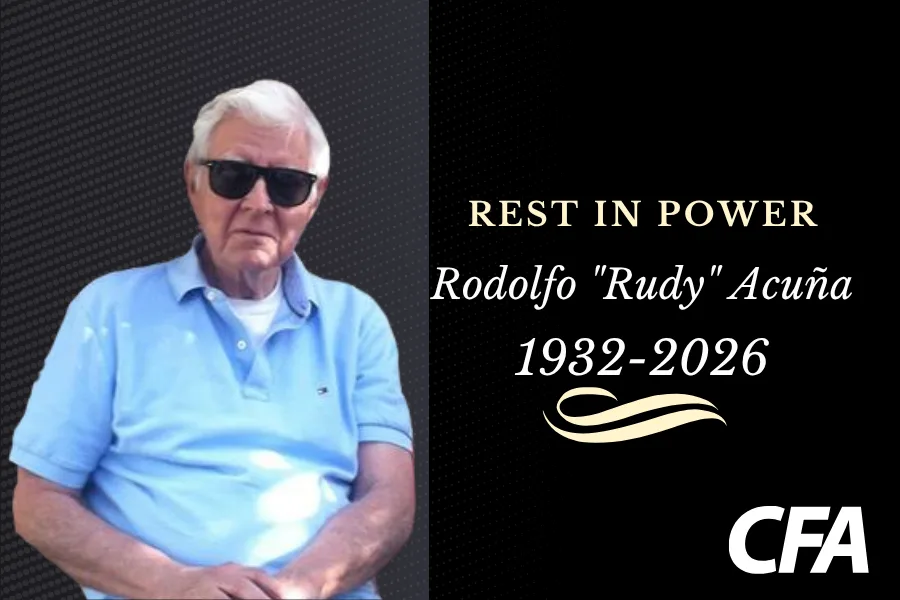
The founding chair of the Chicano/a Studies Department at CSU Northridge (CSUN), longtime CFA member, and activist scholar Rudy Acuña died last month at age 93.
CFA members paid tribute to Acuña as a mentor to faculty members and students. Acuña was also known as the godfather of Chicano/a Studies who helped move faculty to collectively build the largest such department in the nation.
Antonio Gallo, CFA Northridge Vice President of Lecturer Faculty and Faculty Rights Co-Chair and CSUN lecturer, knew Acuña first when Gallo was his student and then as a colleague.
Taking Acuña’s class on the history of Chicano studies was really important to him, Gallo said, because it was the first time he saw someone talk about people that looked like him and not just the contributions they have made to this country, but also the racism that they face. Acuña’s course transformed Gallo’s critical thinking lens and pushed him to go to law school.
“He always made the class really comfortable,” Gallo said. “He’d always pick on us, but in kind of a friendly way. We never felt that he was being disrespectful to us. He always made the class humorous. To some degree, I kind of picked up on that style in the way I teach as well.”
When Gallo began teaching at Northridge, he asked Acuña for advice, such as how to get through to a student. Acuña was also one of the reasons that Gallo said he joined the union.
“He always said that our department was founded on the backs of students who endured violence on campus, who were arrested, who were suspended and expelled from the university so that we could have the department,”
– Theresa Montaño, tri-chair of CFA’s Teacher Education Caucus and a professor at CSUN
Acuña was a strong unionist who was there since CFA’s founding, said Theresa Montaño, tri-chair of CFA’s Teacher Education Caucus and a professor at CSUN . He wanted a union that cared about the students, Montaño said. Even after he retired, Acuña would write emails about student tuition increases and ask what CFA was doing about it.
“He always said that our department was founded on the backs of students who endured violence on campus, who were arrested, who were suspended and expelled from the university so that we could have the department,” Montaño said. “That was our debt of gratitude to those students who established our department.”
Acuña’s primary activism was in the community, Gallo said, and trying to grow the department and getting justice and rights for Chicanos and people of color. After he helped establish the Chicano/a Studies Department, the Educational Opportunity Program (EOP) began at CSUN, and university recruitment of Latinos skyrocketed, Gallo said.
“Now, CSUN, like most CSUs are Hispanic-Serving Institutions (HSIs) and really it was because of this individual that started this and opened doors,” Gallo said. “And now you have Chicano Studies Departments across the country.”
One of Acuña’s most influential books was “Occupied America: A History of Chicanos,” Gallo said. The book covers how America has colonized people of color and Chicanos.
But Acuña never let his colleagues forget that the primary reasons they were in the university were teaching and students, not themselves, their published work, or their research, Montaño said.
Montaño added that there will never be anyone like Acuña. But as much as he meant to his colleagues in the Chicano/a Studies Department, Montaño said he meant much more to the students.
“His legacy is not just that he built the largest Chicano/a Studies Department, but that he built a department that was responsible to its students, community, and the collective liberation of our people first,” Montaño said.
Join California Faculty Association
Join thousands of instructional faculty, librarians, counselors, and coaches to protect academic freedom, faculty rights, safe workplaces, higher education, student learning, and fight for racial and social justice.