
Cal Poly SLO Professor Creates Space for Arabs on Campus and Supports Colleagues
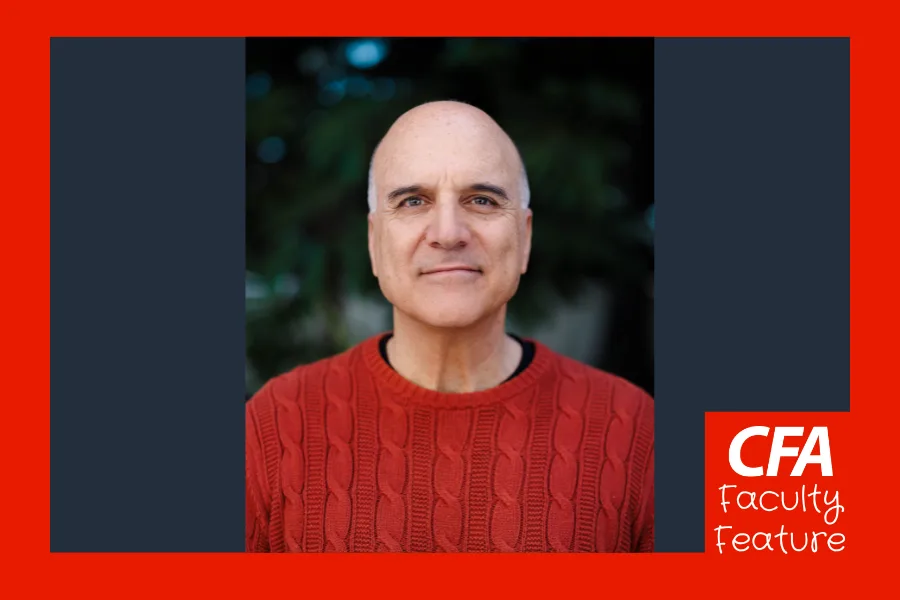
“Don’t ask me where the time has gone, or I’ll have to break into song,” said Ken Habib, CFA San Luis Obispo Council for Racial & Social Justice representative and California Polytechnic State University San Luis Obispo (Cal Poly SLO) professor.
Habib made the reference after sharing that this is his 20th year at Cal Poly SLO. The music professor specializes in ethnomusicology, the study of music and culture that is sometimes called the anthropology of music.
He’s also the director of the Cal Poly Arab Music Ensemble, which performs the art and popular music of Arabic-speaking societies. Habib started the ensemble when he began teaching at the university, and it performs every quarter.
For Habib, the most fulfilling part of the ensemble is seeing students come together and give a great showing of classic Arab music.
“I’m not giving the students ‘Arab music light’ or something like that,” Habib said. “They do some really difficult, deeply rooted, and satisfying material. They just step up and do it, so they are really the best part of the whole thing.”
The ensemble concerts also create a magical space for the Arab community in San Luis Obispo, said Farah Al-Nakib, CFA member and Cal Poly SLO professor.
“It’s such a unique experience when you’re in that room with the ensemble playing and Ken conducting and the history and culture that he shares with the audience,” Al-Nakib said. “As an Arab space, I feel like it is the only moment where I truly feel that I get to take pride in my Arab culture on our campus. It’s celebrated so explicitly, and he’s done such a great job of bringing people together as musicians and community members who play in the ensemble, but also there’s a dedicated community who come to every concert.”
Ashraf Tubeileh, CFA member and Cal Poly SLO professor, sings in the ensemble. Tubeileh said Habib provides leadership and direction for the group, which includes students, staff, and faculty.
Habib mostly directs and conducts the ensemble, but he has also sang and played instruments with the group. One of Tubeileh’s favorite memories with Habib was when the ensemble performed together on a bus ride back from a trip to San Franciso. Habib played the oud, an Arab lute, during the ride.
Outside of the ensemble, Habib is also a composer, performer, and poet. He began his artistic life at about 10 years old, writing poems and songs and teaching himself to play guitar and sing. Habib has an album on Spotify and a few performances on his YouTube channel. His poetry has been published in the San Luis Obispo Tribune.
Habib joined CFA to support our union because the average worker is in a lopsided system. He said he wound up in leadership positions not because he sought them, but because somebody asked him to take them.
Serving as the CFA San Luis Obispo Council for Racial & Social Justice representative is a natural fit for him because he has been involved in protests for civil rights issues, including Palestine, and for ecological issues, including opposition to nuclear power, since he was a teenager. The first songs he learned were anti-war themed.
“It’s imperative that we speak for the people who’ve been deprived of their voice,” Habib said. “I only wish I was more outspoken for all disenfranchised people.”
Tubeileh said Habib is humble. Habib is always there, Tubeileh said, at social justice events on campus. He’s active in political organizing.
Al-Nakib also spoke to Habib’s character and commitment to justice.
“For Ken, social justice and equity are not just abstract concepts,” Al-Nakib said. “They’re very, very deeply grounded in everything he does. The way he thinks, and he’s a brilliant mind and scholar, too. I think that also just contributes to his ability to think really, deeply, and it’s one of the reasons why he’s the person that I would always really turn to.”
Despite being busy, Habib always makes himself available if people need him, especially when it comes to the union, Al-Nakib said. Habib talks things through with people and is generous with his time, she added. Whenever she has certain issues that she wants to talk with someone about in confidence, Al-Nakib always goes to Habib.
Tubeileh has also gone to Habib for union-related advice.
“He made me feel not alone, very supported, and like having people that I can rely on,” Tubeileh said. “He makes you feel like he’s there for you.”
Tubeileh added that Habib has flirted with retirement, but he hopes that Habib sticks around for as many years as possible.
One issue that Habib hopes to address in retirement or during a sabbatical is finishing writing a book on the eminent Lebanese singer Fairuz. He has written his dissertation and articles on her and her composers.
You can read more about Habib’s work on Fairuz here.
Join California Faculty Association
Join thousands of instructional faculty, librarians, counselors, and coaches to protect academic freedom, faculty rights, safe workplaces, higher education, student learning, and fight for racial and social justice.