
Art Against Austerity: Resisting a Tragedy Unfolding
Ninety years after its founding in 1935, the Liberal Studies program at San Francisco State (SFSU) is slated for discontinuation. Aggressive downsizing and program discontinuance is now playing out among numerous departments at San Francisco State. While tenured faculty may be reassigned to other departments, lecturer faculty, already cut to a skeleton crew, have little hope of keeping their jobs.
This instability provided the framework for last week’s Orange Week at SFSU, which included theater, art exhibits, films, talks, poetry slams, organizing workshops, a “bonfire of the humanities,” and a revival of the annual SFSU Human Rights Summit. The events provided faculty and students an opportunity to dramatize and organize against the CSU administration’s toxic mismanagement.
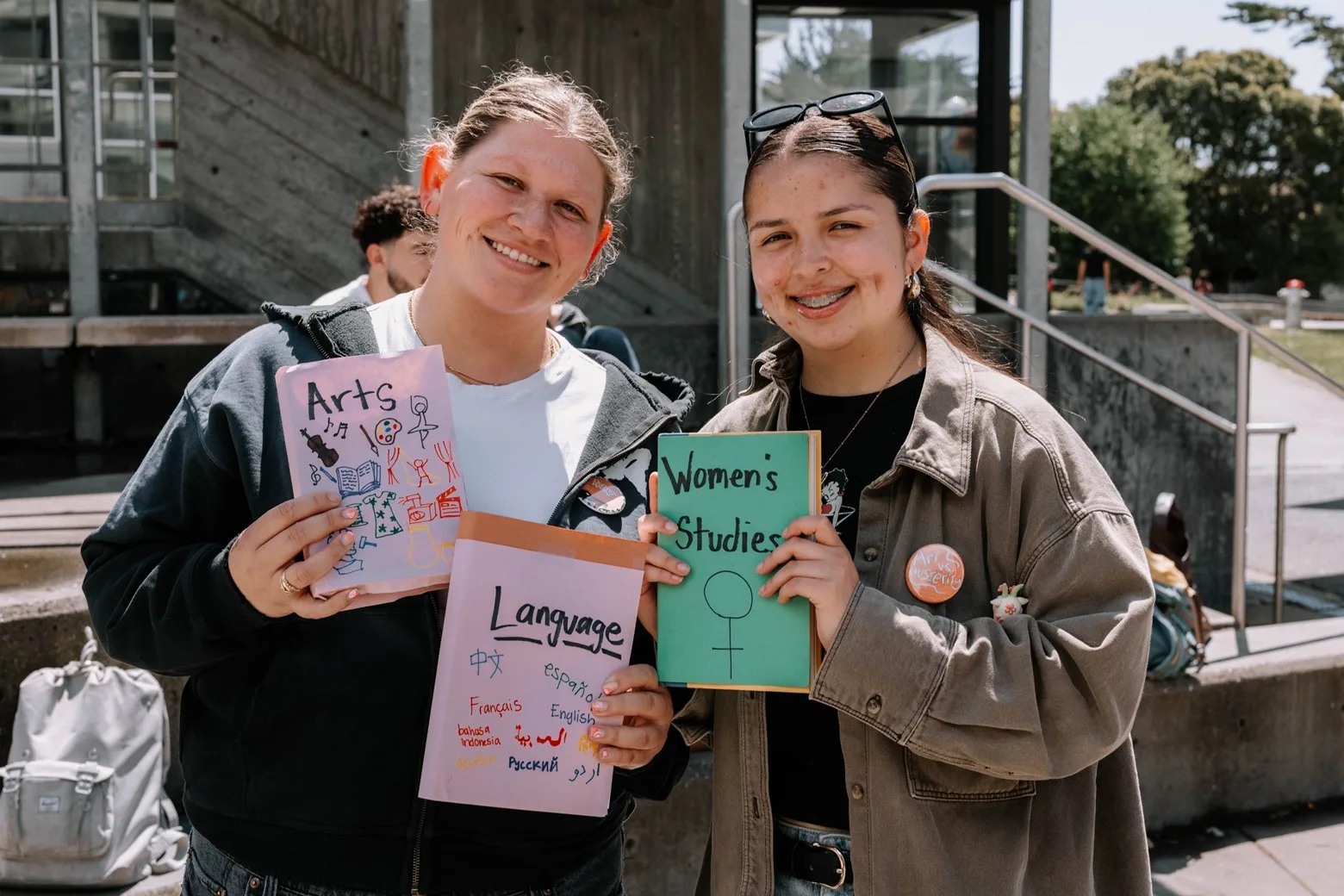
Orange Week draws its name from the “Orange Book,” a nickname for the pre-1993 CSU/state cost model. Its formal title was: The CSU Budget Formulas and Standards Manual.
Students and faculty passed out an orange booklet explaining that the manual’s framework was abandoned in the 1990s, freeing chancellors and campus presidents from their former accountability in how they spent public money, leading to a precipitous drop in the percentage of the CSU budget dedicated to instruction: from 53% in 1993 to 34% today. This neoliberal policy shift unleashed administrative bloat, growing class-sizes, unsafe counselor-to-student ratios, the adjunctification of faculty and financialization such that $13.2 billion has been siphoned from the classroom to cash reserves and speculative investments.
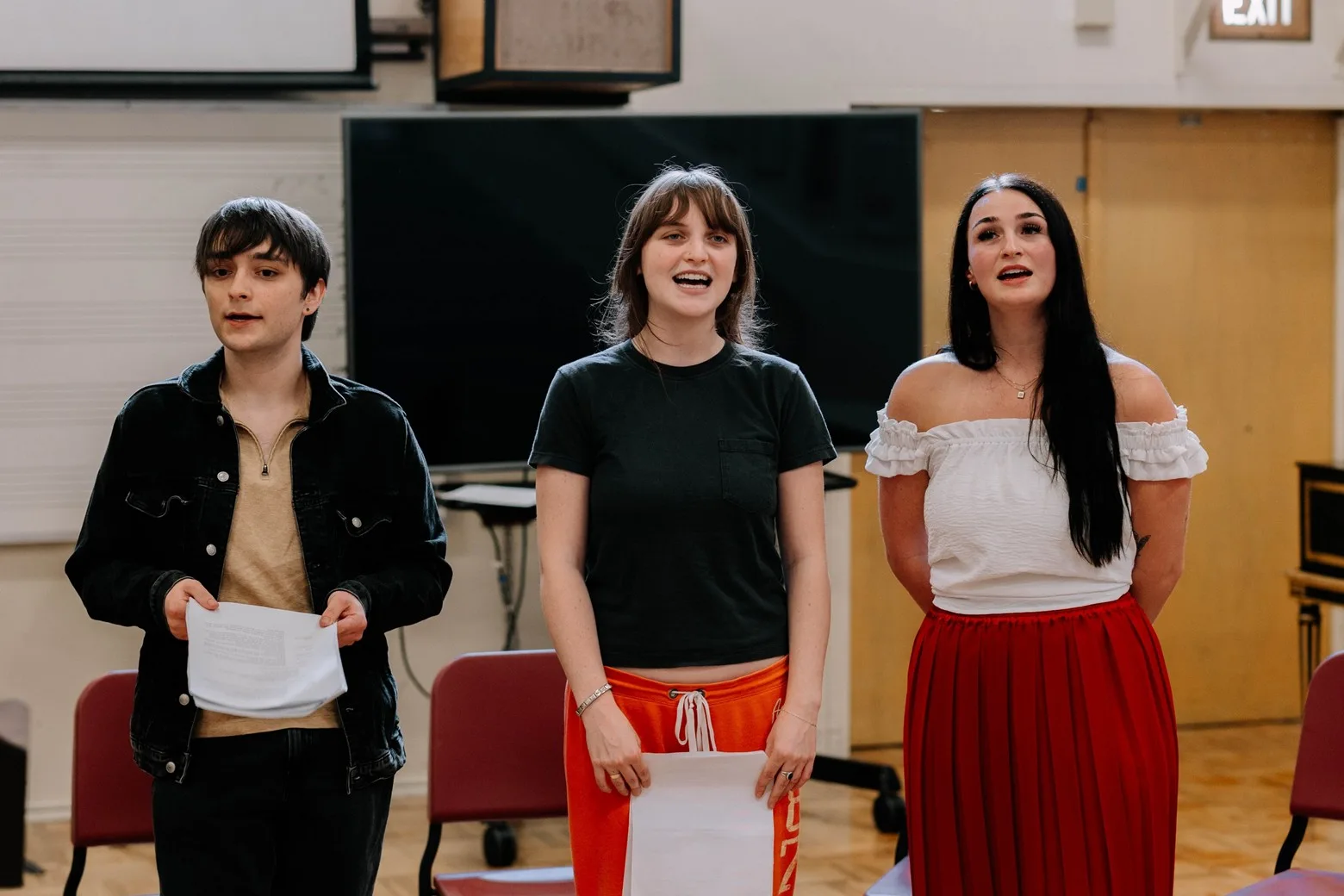
Inspired by Bertholt Brecht’s 1928 Threepenny Opera, Brad Erickson, CFA-SFSU president and faculty lecturer in Liberal Studies, wrote The Threepenny University, a musical play performed with his students during Orange Week. Like Brecht’s play, it offered a socialist critique of the capitalist world, while updating the setting to a CSU beset by turbocharged financialization and assaults on academic freedom and shared governance. The criminals, capitalists and lumpenproletariat of the Threepenny Opera are reincarnated as CSU administrators like Chancellor Millie the Moocher, Dean of Deans JJ Teachum, Campus Conduct Compliance Officer TP Emsworth, President Krampus, Provost Polly and their victims: debt-saddled students and overworked, ultraprecarious or unhoused former faculty.
The play opens at a lavish holiday party held in Chancellor García’s palace. There, administrators shower García with praise for her leadership remaking the CSU as a capital investment firm. JJ Teachum and his AVPs, Chad and Tad, sing “You can rule”:
No more freedom of speech or shared governance
Unions gone—
See the faculty floundering rudderless
Students tamed—
All those debt-saddled saps paying through the nose
So it goes, you’re so slick you can take every trick, you can rule!
Dollars flow—
Siphoned off from the classroom in mass amounts
Your trustees—
Fuel the privatization overhaul
By degrees—
We’re no longer expected to teach at all
Asset growth—
Is the wind in our sail, our holy grail
This is your sacred quest: take it all and invest! You can rule!
In the second act, besieged and struggling faculty and students despair:
We can’t afford to imagine what liberation could be.
Curiosity’s gone, and compassion? There’s a hole where that used to be.
We’ve lowered our low expectations.
From crisis to crisis we crawl.
We can’t afford to imagine, at all…
Erickson’s play portrays the chancellor’s path to total domination paved by hopeless, disengaged faculty in order to dramatize the urgent need for organized, collective action.
“When university workers are checked out and indifferent to their unions, we all become vulnerable,” said Erickson. “Many faculty don’t see themselves as workers but as professionals, yet in essence we are the same as any other worker. To think otherwise is an illusion, because we don’t own or control our means of production; management does. As individuals we can only respond from a place of weakness, but we are stronger together.”
Erickson revived the Human Rights Summit to honor his friend and mentor, Mariana Ferreira, an SFSU professor who passed away last summer. Ferreira, who had led the summit for ten years, was also the creator of the course “Performance & Pedagogy of the Oppressed for Educators,” a course fusing revolutionary theory to embodied practice that Erickson now teaches. He said, “by performing a play that explicitly addresses conditions faced by performers and audience, we enact Boal’s Theater of the Oppressed and Brecht’s Lehrstücke, participatory learning that collapses the separation of theory and practice, teacher and learner, performer and audience.”
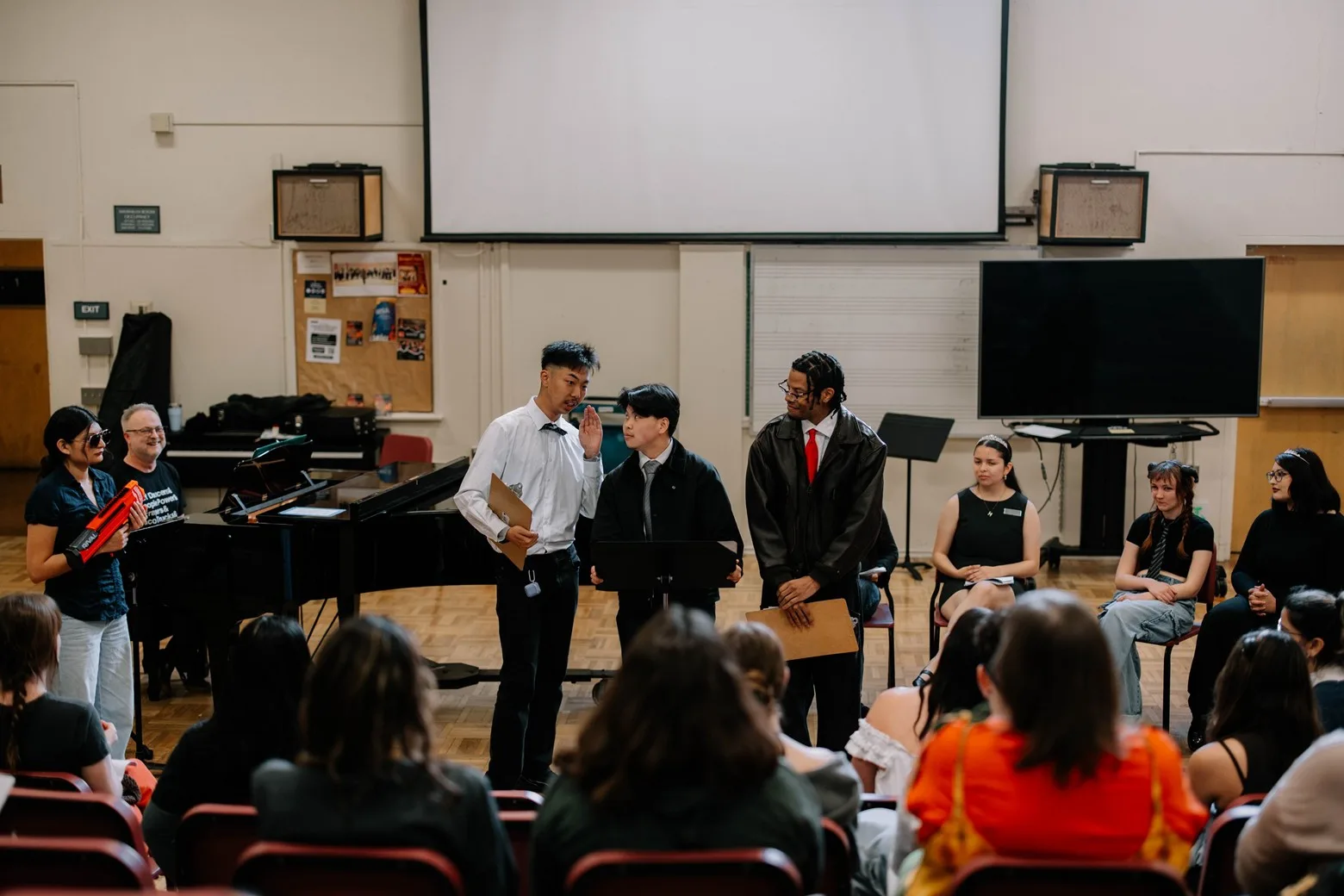
“While every Human Rights Summit focused on organizing, it also incorporated the arts, not as a less important distraction, but as a way to pinpoint human experience and intensify the stakes of human rights,” said Erickson. “I thought of Mariana while we were on stage: students singing and hamming it up, audience laughing or jeering the Chancellor character. When our popcorn machine set off the fire alarm, we continued the third act outside with everyone crowded into a pathway, audience and actors mixed together in concentrated, joyous resistance.”
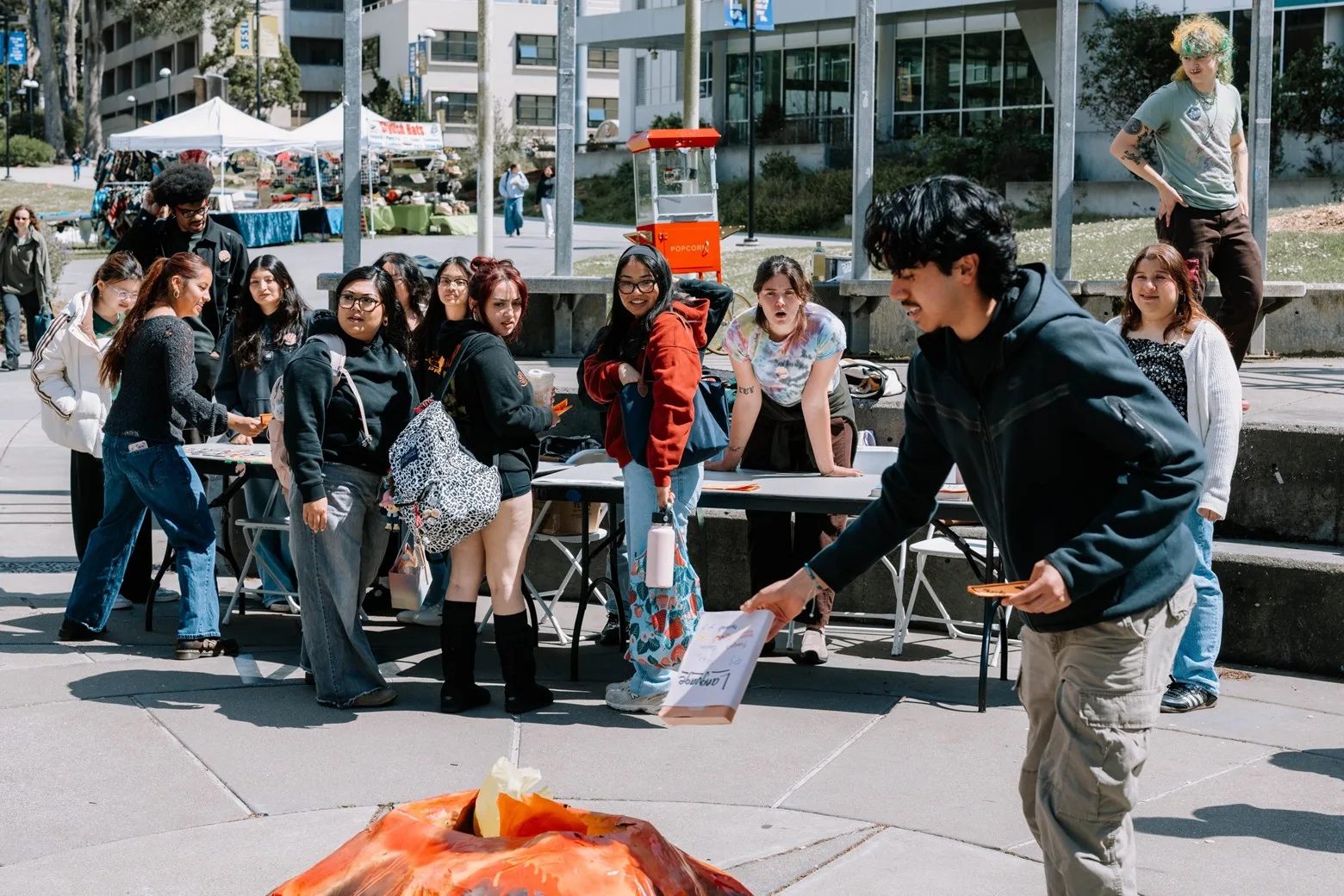
Nicole Banducci, a third-year Liberal Studies student at SF State, shared her concerns about the program’s future closure and why these art activities matter. She helped organize the “bonfire of the humanities” activity, in which passersby would throw books labelled with the names of discontinued liberal arts programs at SF State into a giant volcano, dramatizing the broader assault on humanities in public higher education.
“CSU administrators are removing a lot of money from the classrooms and putting them into AI programs and non-operational investments,” said Banducci. “I didn’t know ITEP (the Integrated Teacher Education Program) and the Liberal Studies program were being cut until after I started the programs. We are bringing awareness to this because it is a big deal, and our event shows other students what we are missing out on. It is affecting us and pushing people away from SF State.”
As Erickson explains, over 615 faculty lost their jobs at SFSU in just the past two years, and he may soon lose his as well. With emotion in his voice, he explained his affinity for his current department. “I’ve taught in eight departments at five universities, with three of those departments at SF State. I’ve only been in Liberal Studies since 2015, but with respect to my students and my coworkers, and the way I’ve been able to integrate teaching and research and organizing, it’s been the best place I’ve ever worked.”
Suzanne Pullens, a CFA San Francisco member and SFSU lecturer faculty, attended the play and described to students afterward just how little faculty get paid and how serious the impacts of the cuts are. She stated that the number of lecturer faculty in her Department of Communications Studies has gone from 47 to just four since the pandemic.
“Chancellor García’s $80,000 of deferred payment would pay for my entire salary,” she said. “That’s how much I get paid here with a PhD and 11 years of teaching experience. When you think of the dedication of the faculty who are staying here, it’s because we love being here… but we can’t afford to love being here much longer.”
Erickson explained that SFSU administrators tried to justify the program discontinuances by claiming that SFSU has too many majors compared to other campuses, and that it was necessary to consolidate. He pushed back against flattening the diversity of CSU campus offerings.
“The CSU is great because it offers so many different concentrations,” said Erickson. “For example, SF State is the birthplace of Ethnic Studies, and it has very strong arts programs. Many unique and distinct programs are being erased through cuts and program discontinuances, and it’s being done without shared governance. And they haven’t demonstrated financial or pedagogical benefits.”
The last cohort of Liberal Studies students will be admitted in the fall, and Erickson will teach out the remainder of the students before his employment evaporates. He encouraged both tenured and contingent faculty to consider the shaky ground we tread on.
“Tenured faculty may feel more secure in their freedoms and agency because they’ve generally been able to teach, research, and publish as they like, with institutional support,” said Erickson. “But, at SF State, it’s becoming increasingly obvious that none of this can be taken for granted. They’re having to wake up to the lack of agency that most lecturer faculty have experienced all along, given our precarity, lack of equity in pay and workload and normative exclusion from shared decision-making.”
Rather than admit defeat, however, Erickson urges unity.
“This is an opportunity to build solidarity, to build shared consciousness as workers under capitalism,” he stated. “It doesn’t mean we’re all going to agree on everything, but we still need to fight for each other. I have to have solidarity with my tenure-line colleagues, just as they need to have it with me, because we are all in the same union. It’s going to take a lot of work, a lot of door-knocking, one-on-one conversations, and we have to do it without leaving anyone behind.”
For Erickson, his play wasn’t just a way to demonstrate the relationship between the arts and social change, but a way to lampoon the chancellor and management’s destructive behavior and to highlight the perseverance and resistance of faculty and students acting collectively.
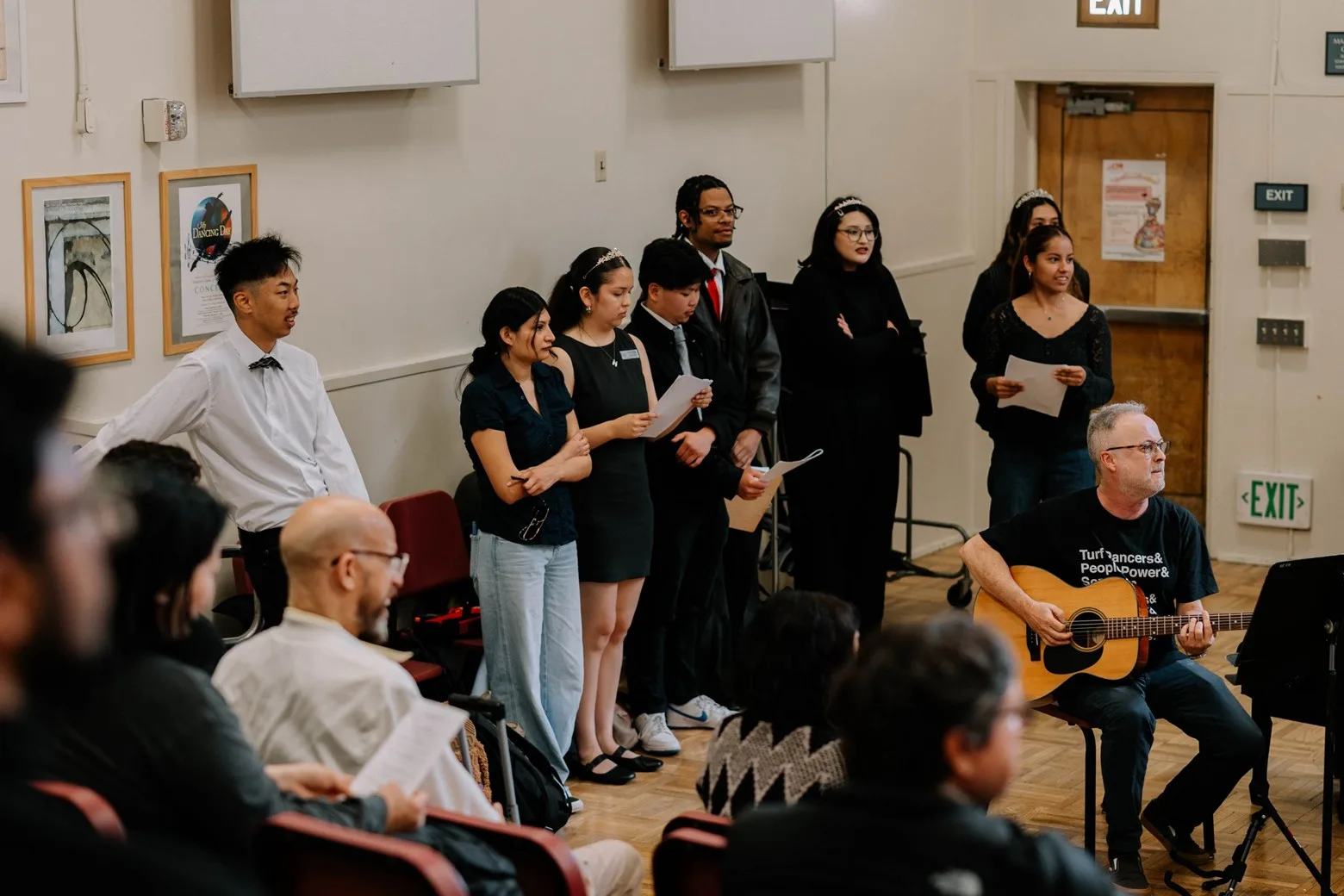
Throughout its three acts of carnivalesque laughter and reversals, the audience moves from a world in which administrators hold the power to one in which faculty and students take back that power.
The final act models an aspiration of what the university could look like should we take charge, and what could happen, as Erickson puts it, “when we organize from the bottom but strike at the top.”
“Millie tried to fool us all. She’s now in the detention hall.
Our campus is tuition-free!
The people’s university!
ICE is banished, except in drinks; Millie’s chilling in the clink.
We fought back their austerity.
The people’s university!
TPM has been demolished; student debt has been abolished.
No two-tier system; speech is free.
The people’s university!
The people’s university!
With bottom-up democracy.
We took away their power, YOINK!
Bye, bye, Millie, OINK, OINK, OINK!”
Join California Faculty Association
Join thousands of instructional faculty, librarians, counselors, and coaches to protect academic freedom, faculty rights, safe workplaces, higher education, student learning, and fight for racial and social justice.