
CSU East Bay Spanish Degree Program Granted Additional Time After Collective Efforts Led by Spanish Professor’s Commitment to Students
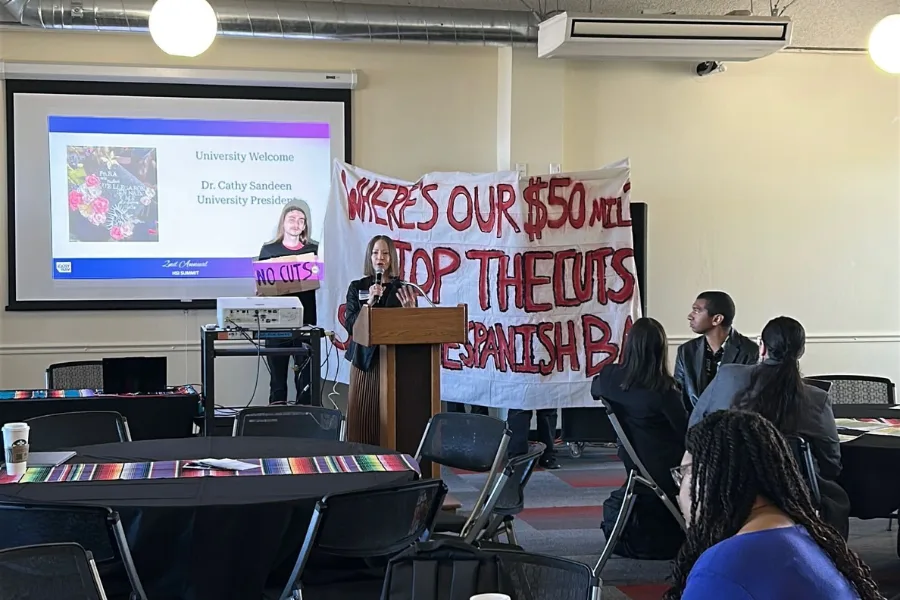
On March 30, while students, faculty, and staff were away on spring break, CSU East Bay (CSUEB) President Cathy Sandeen and CSUEB Provost Anthony Muscat sent a message informing them that the Spanish Bachelor of Arts (BA) program, previously slated for elimination in Spring 2027, would be extended by one academic year so that it can undergo its scheduled five-year review through the standard program review process.
Originally planned for discontinuation in Spring 2026 following the Focused Program Review, the program was granted an additional year for review after backlash from faculty and students, and sustained pressure from campus and local community members.
This win may seem like a small victory for those who labored to preserve the program, but the lessons learned throughout this endeavor about organizing, coalition building, and the power of solidarity will ultimately shape future efforts to resist program eliminations.
“What keeps me going is the people who kept fighting,”
– Díaz-Dávalos
From a campus that has been left hollow following the pandemic and the 2024-25 austerity measures that forced hundreds of CSUEB faculty to lose their jobs, saving the Spanish BA program for now wasn’t just about protecting a major… it was about sustaining a community.
At the forefront of this fight was Gabriela Díaz-Dávalos and Marcelo Paz, two CFA East Bay members and CSUEB professors in the Department of Writing, Languages & Literatures. Initially hesitant to speak up and lacking any organizing experience, Díaz-Dávalos found herself thrust into a political and cultural struggle. She ultimately emerged as one of the champions of not only the Spanish BA program, but what it represents to so many people in her community.
The Spanish BA program, which had a handful of faculty before the layoffs, now has two tenure-line professors and one lecturer.
Díaz-Dávalos began teaching at CSUEB in 2022. When it was first announced over the summer that the Spanish BA program would be discontinued, she was on maternity leave with her second child and dealing with frequent illnesses that caused repeated visits to the emergency room.
However, the impending crisis forced her to do something. “I really didn’t want the spotlight on me,” Díaz-Dávalos said. “It’s a lot easier to speak more freely on these issues when you’re tenured, but I couldn’t stay silent. I didn’t have a choice.”
Although President Sandeen reassured Díaz-Dávalos that she would still be teaching Spanish classes, she was more concerned that the program discontinuation would be a disservice to the students and felt dishonest if she informed them not to worry.
Díaz-Dávalos questioned the rationale behind the discontinuation, noting there would be no financial savings by eliminating the Spanish BA program, since all Spanish courses would continue to be offered. The university also had resources, she said, including Hispanic Serving Institution (HSI) grants and a recent $50 million donation from McKenzie Scott. Additionally, the university earned the Seal of Excelencia in 2024 in recognition for its commitment to advancing the success of Latinx students. It is only one of 48 institutions in the nation to receive this certification.
While the Low Degree Conferring Task Force (LDC) had reported low enrollment in the program and cited that as a reason for discontinuation, Díaz-Dávalos said that public access to Pioneer Insights data was limited, making it difficult for anyone to verify the numbers. “I felt like there was a hidden agenda,” she said. “It seems like a decision was already made to eliminate the program.”
What made the proposed program elimination even more concerning was that it appeared to conflict with the spirit of earlier review recommendations (see 25-26 CAPR 19: Resolution), particularly because the Department of Modern Languages & Literatures had just merged with the English Department during the 2024-25 academic year and undergone a significant transition. The Spanish BA had also followed recommendations from its last five-year review, completed substantial curricular revision, and created and advertised an online degree completion pathway.
Program supporters also point to updated data showing that the program had begun to grow. According to the CSUEB Committee on Academic Planning and Review (CAPR), the number of majors rose from 17 to 27, not including double majors, while Full-Time Equivalent Students (FTES) increased from 11 to 21, likely aided by the online modality. The program has an unusually large number of double majors for a program of its size, including students who are often excluded from formal calculations but who still contribute meaningfully to program viability.
The program also does not appear unusually expensive compared to other bachelor’s programs. CAPR reported that the Spanish BA program consistently has a near-median cost among bachelor’s degree programs at CSUEB, undermining claims that it is financially out of step with comparable programs.
Unsure of what to do, Díaz-Dávalos reached out to her colleagues for help. They directed her to CFA and her campus’ academic senate. Coincidentally, Kim Geron, past-CFA vice president and professor emeritus at CSUEB, reached out first.
Geron stressed to Díaz-Dávalos the need to build a united front with campus and community allies. Without hesitating, Díaz-Dávalos got to work.
“[Geron] guided me through everything I needed to do,” said Díaz-Dávalos. “And I did every single thing he told me.”
While managing illness, caring for two children, fulfilling research obligations, and teaching classes, Díaz-Dávalos somehow mustered up the strength to get more than a dozen organizations, including the faculty senate, alumni and current students, and more than half a dozen departments as well as campus committees to write letters of support to President Sandeen. She also went to her colleagues’ classes to speak to students directly.
Her efforts initially began on campus and then expanded outward towards the broader community. The campaign led to a publication in the student newspaper, “The Pioneer,” which then got picked up by a local Hayward newspaper. Díaz-Dávalos also reached out to Spanish-language media outlets to raise her concerns.
Support continued to grow with the help of other CFA members. Jim Murray, CFA East Bay president and CSUEB professor, played a key role in spreading awareness of what was happening to the Spanish BA program, while Amara Miller, CFA East Bay vice president and CSUEB professor, drafted a petition that garnered over 400 signatures.
Díaz-Dávalos further secured support from the California Latino Legislative Caucus, as well as Assemblymembers Liz Ortega, Damon Connelly, Alex Lee, Mia Bonta, Patrick Ahrens, Timothy Grayson, Jesse Arreguin, and Aisha Wahab to draft a letter urging Sandeen to reverse her decision to cancel the program.
In Ortega’s letter, she explains how the president’s decision has troubling implications for equity and access and sets a dangerous precedent.
“Cancelling a major directly related to targeted communities sends the wrong message to students and the greater East Bay and CSU community,” Ortega said. “Students are watching their communities be torn apart, some losing family and friends, solely based on their appearance and the language they speak. Students should not be further ostracized by witnessing their campus also devalue a major tied to their cultural identity.”
“Eliminating the Spanish BA program doesn’t remove barriers; it creates them,” Díaz-Dávalos said, pointing out the absurdity in CSUEB being an HSI but being unable to earn a Spanish degree. “The program serves students who are balancing work, family responsibilities, and structural barriers. You would be punishing these students rather than supporting them by removing the program. Students don’t need more bureaucracy or obstacles. They need choices and career pathways.”
When the news finally broke that the program had been granted another year, President Sandeen’s message included the false claim that she never intended to discontinue the Spanish program. Critics argue that this statement blurs the distinction between continuing to offer some Spanish courses and preserving the Spanish BA itself, which faculty and students had clearly understood to be at risk.
Geron spoke to the pattern of mismanagement that the public is witnessing across the CSU.
“One of the bigger challenges for smaller programs, not just Spanish, is the larger austerity campaign that the CSU is implementing to try and consolidate programs,” Geron said. “They want to get rid of a lot of lecturers, as they’ve already been doing.”
While he acknowledged the one-year extension as a win, he shared that the fight is far from over. With more than 40% of CSUEB students being Latinx, Geron explained how a Spanish major helps them retool their bilingual skills into future employment opportunities.
“Why the Spanish program is being singled out when enrollment is growing is a reflection of how out of touch administrators are to the importance of the kinds of programs that really serve our community,” Geron said. “We really need to do some revisioning of what it is to serve our Hispanic and Latino students.”
Díaz-Dávalos expressed gratitude for everyone who helped protect the program and felt empowered to know she had so much support through it all.
“What keeps me going is the people who kept fighting,” she said. “This is a small but meaningful win, but what matters is that people refused to let this program disappear quietly. That collective voice turned silence into resistance, and resistance into possibility for the Spanish program”.
Join California Faculty Association
Join thousands of instructional faculty, librarians, counselors, and coaches to protect academic freedom, faculty rights, safe workplaces, higher education, student learning, and fight for racial and social justice.