

How CSU Trustees Got Duped Into Approving Huge Base Salary Increases for Presidents (Using CSU Operating Funds)
In our last headlines, we covered how the CSU Board of Trustees, including the chancellor, approved a policy that gave extravagant raises to the highest-paid executives in the CSU. As CFA members continue to fight back, here, we uncover more about the CSU’s mismanaged funds.
Assemblymember Patrick Ahrens immediately issued a statement condemning the outrageous pay increases. He asserted that “administrators already being paid more than the President of the United States is a moral outrage and breach of the public’s trust.” Ahrens outrage was amplified because the Board previously decided to raise student tuition by 36% to “help” cover administrative costs.
This is the problem. Contrary to appearances, CSU operating funds—which are funded by state appropriations and tuition revenue—are directly being funneled into enormous base salary increases for the presidents: the wealthiest people in our system. Before these additional raises, CSU presidents were making an average of $450,285 in their base salary alone.
What’s appalling isn’t just the recent raises themselves, but the sleight of hand at play. Both the chancellor and Frank Hurtarte, the CSU’s Executive Vice Chancellor of Human Resources, appear to deliberately mislead the trustees into believing that student tuition and state funds would not go toward increasing executive compensation, when they knew all along that they would.
How did this deception happen?
At the CSU Board of Trustees meeting on November 19, trustees spent more than two hours discussing how CSU executives must be paid substantially more.
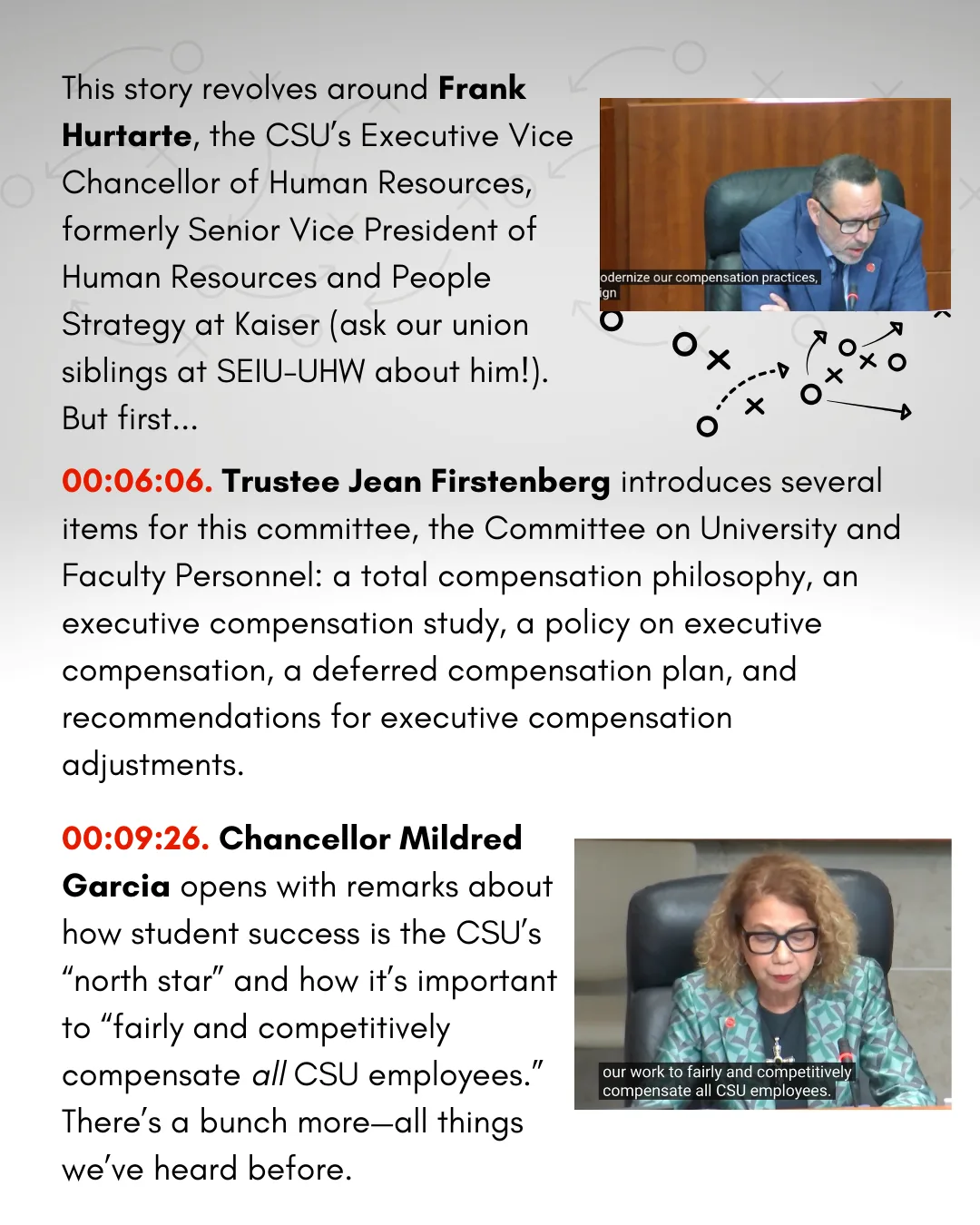
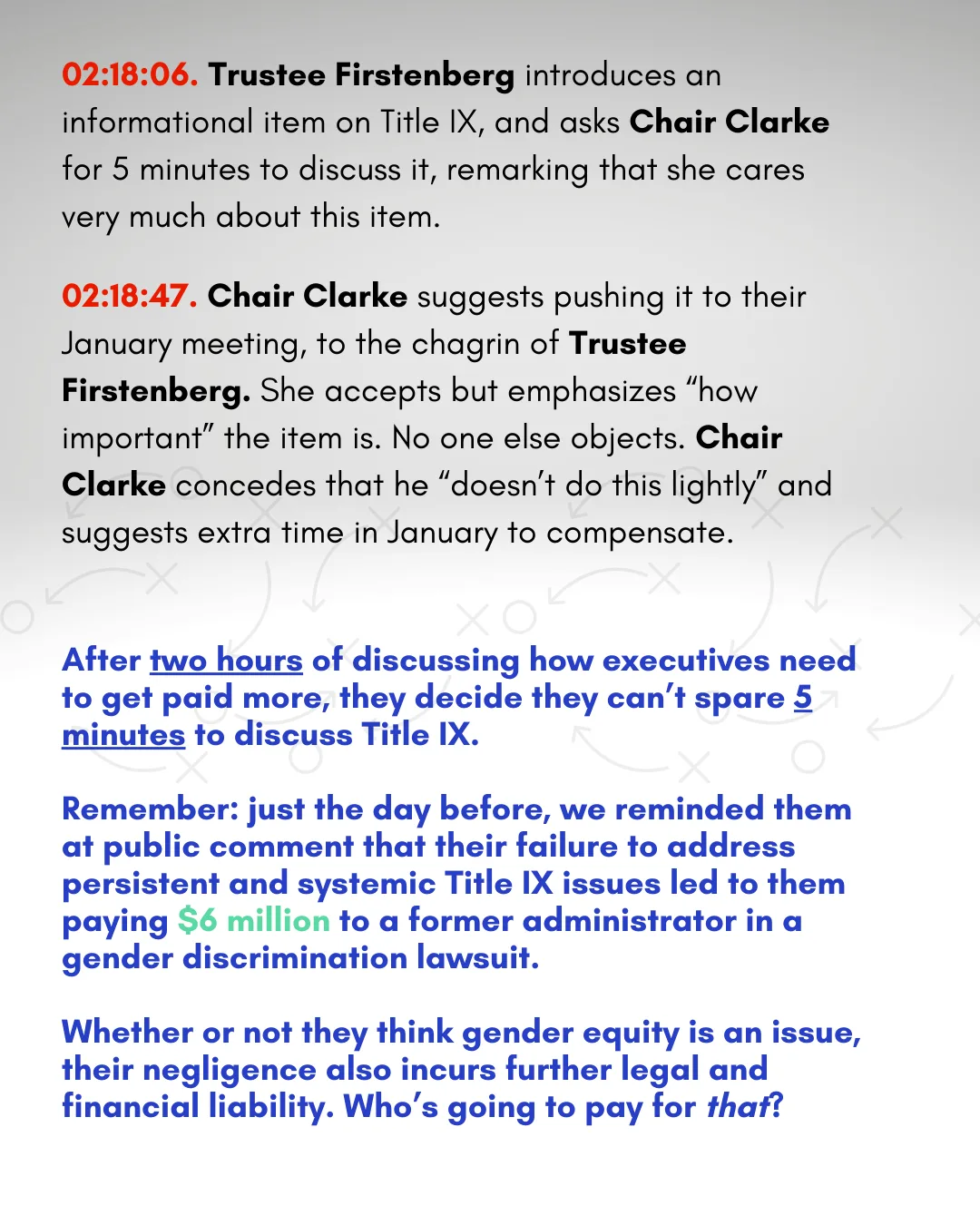
Hurtarte introduced the CSU’s Total Compensation Philosophy, which supposedly lays out a commitment to faculty, staff, and administrators by aligning pay and benefits with CSU’s mission and long-term goals. However, the discussion focused exclusively on an executive compensation study that included a policy on executive compensation, a deferred compensation plan, and recommendations for adjustments to their current compensation.
(The recording of that committee is here, and the agenda for it is here.)
During the discussion, Trustee Julia Lopez said that we are living with a reality of constrained resources and making choices as best we can within that reality, then went so far as to say that the only thing that has not made the past few years worse in the CSU is the Board’s decision to increase student tuition by nearly 40%.
This is disturbing, given that tuition is, as we’ll find out, being used to pay the exorbitant salaries of these presidents.
Hurtarte introduced a report from the Segal Group, a private HR consulting firm, to back the claim that CSU presidents are underpaid relative to other university presidents across the nation.
However, the comparison of CSU president pay to other university president pay draws serious concerns, as Rama Malladi, CFA member and finance professor at CSU Dominguez Hills, pointed out. “The market study used to justify the executive compensation uses national universities often in states that are thousands of miles away from California, and do not include California’s community colleges (CCC),” Malladi said. He explained that many of the CCC presidents make 50% or less than CSU presidents. “Excluding the community colleges from this comparison raises questions about the consistency of the methodology and how we have conflated executive compensation in the CSU.”
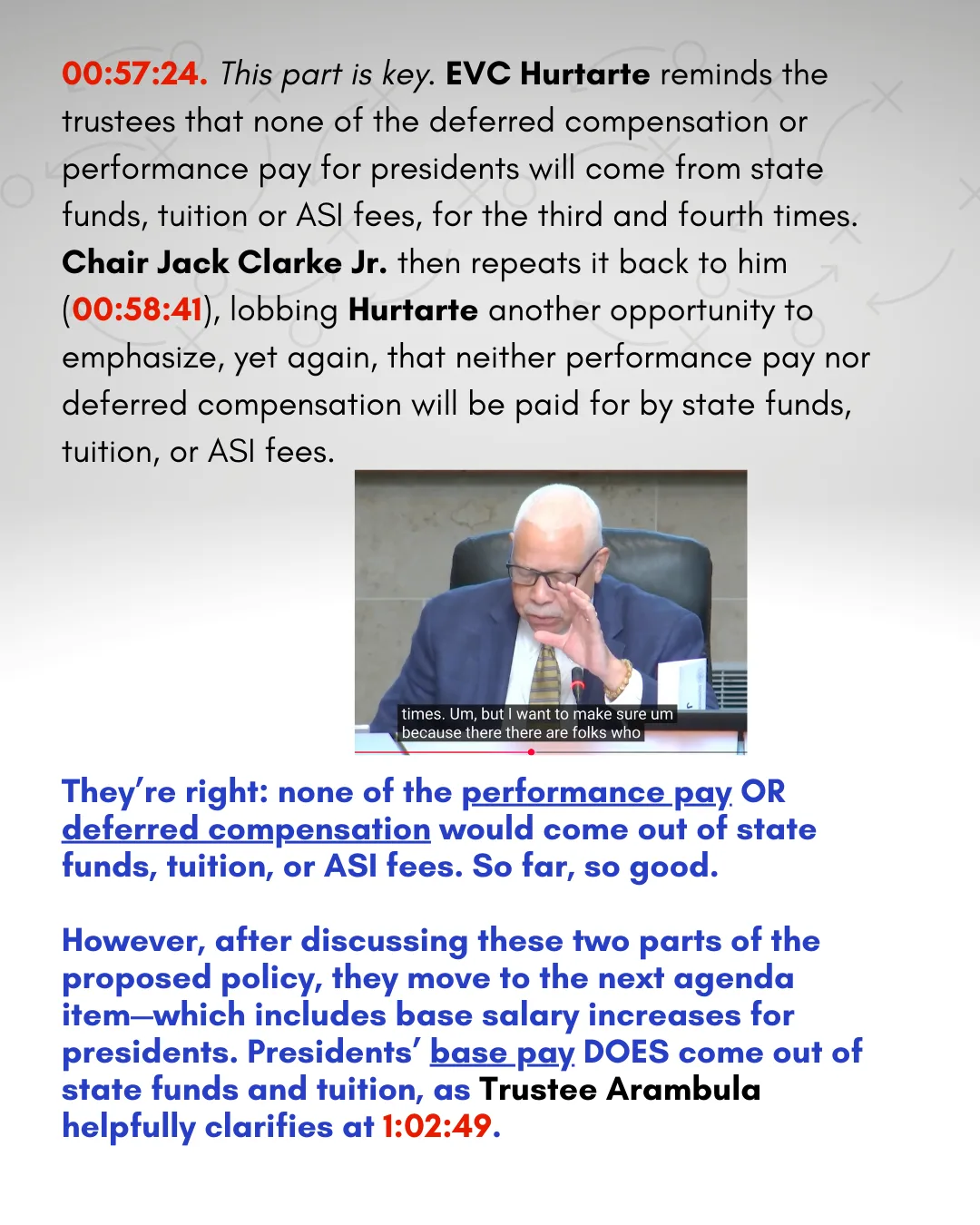
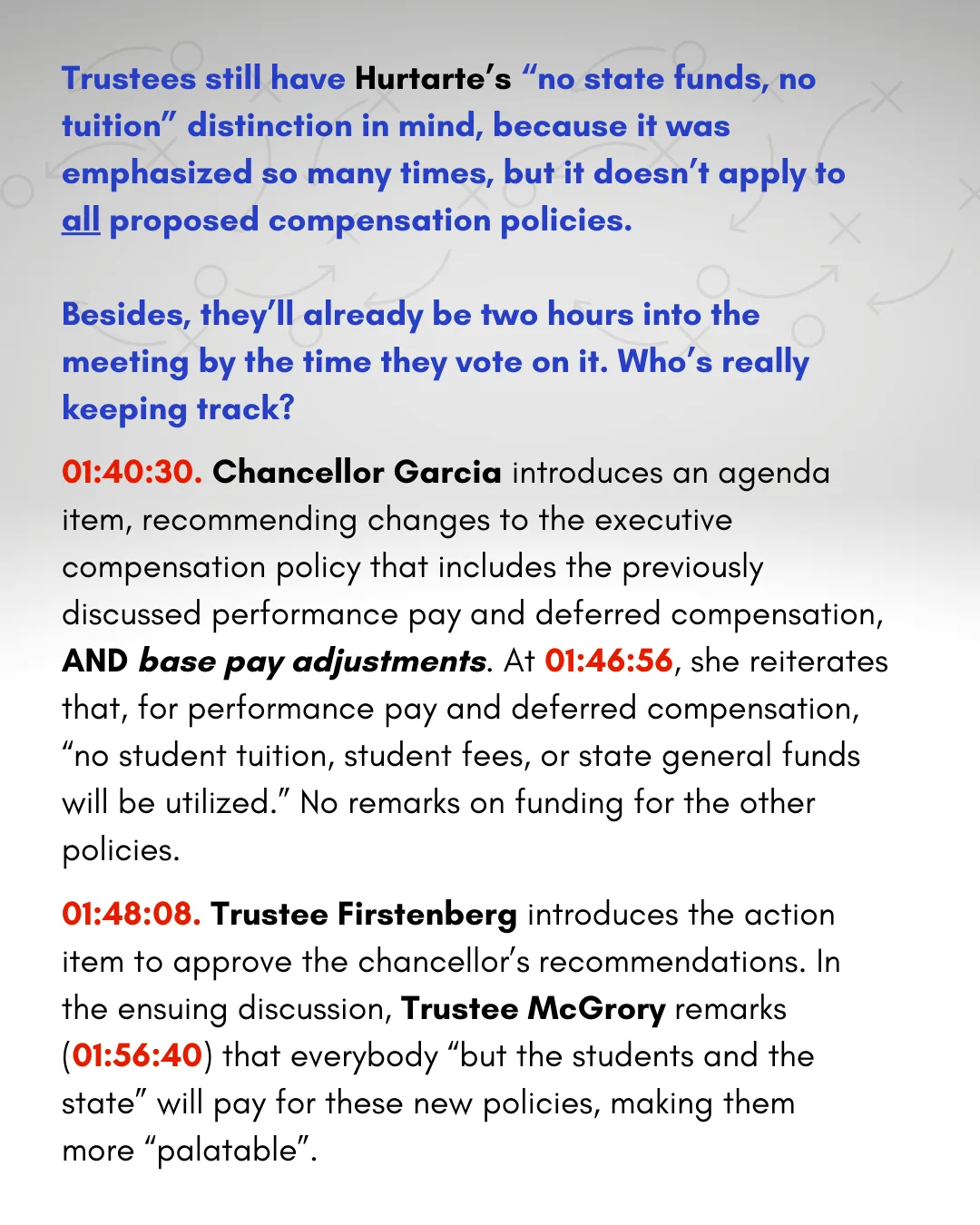
Hurtarte summarized the proposed executive compensation policy, which includes performance pay and deferred compensation as well as annual salary increases and a removal of the 10% cap on increases to a president’s salary over their predecessor’s salary. He repeatedly emphasized four times that the former two—performance pay and deferred compensation—would not come from state funds, tuition, or Associated Students Incorporated (ASI) fees. This distinction will be critical later.
After the trustees discussed the performance and compensation parts of the proposed policy, they moved to discuss base salary increases. Here, Trustee Arambula fleetingly mentioned that base salaries would be paid with tuition and state funds, but the discussion moves on without any acknowledgment of this important point.
What happens next is key: Chancellor García proposed the recommended changes to the executive compensation policy that includes the discussed performance pay and deferred compensation, along with base pay adjustments. She then reiterated that the former two would be funded through “non-state, non-tuition, and non-student fee resources.” She repeated her claim: “This is critically important,” García said. “No student tuition, student fees, or state General Funds will be utilized.” This is intentional misdirection away from Trustee Arambula’s comment.
The chancellor and Hurtarte are intending to fool listeners into believing that students will have nothing to do with these raises. In reality, the money used to pay for presidents’ base salaries will come directly from students and taxpayers!
What makes all of this worse is the timing of these decisions. “Key compensation documents were released publicly at the last possible moment, and the [Board of Trustees] meeting schedule was shifted on the final day,” said Malladi, who offered public comment during the meeting. “This made it difficult for many employees and students to review the material or offer informed public comments. Meaningful participation requires predictable scheduling and adequate time to analyze these complex financial proposals.”
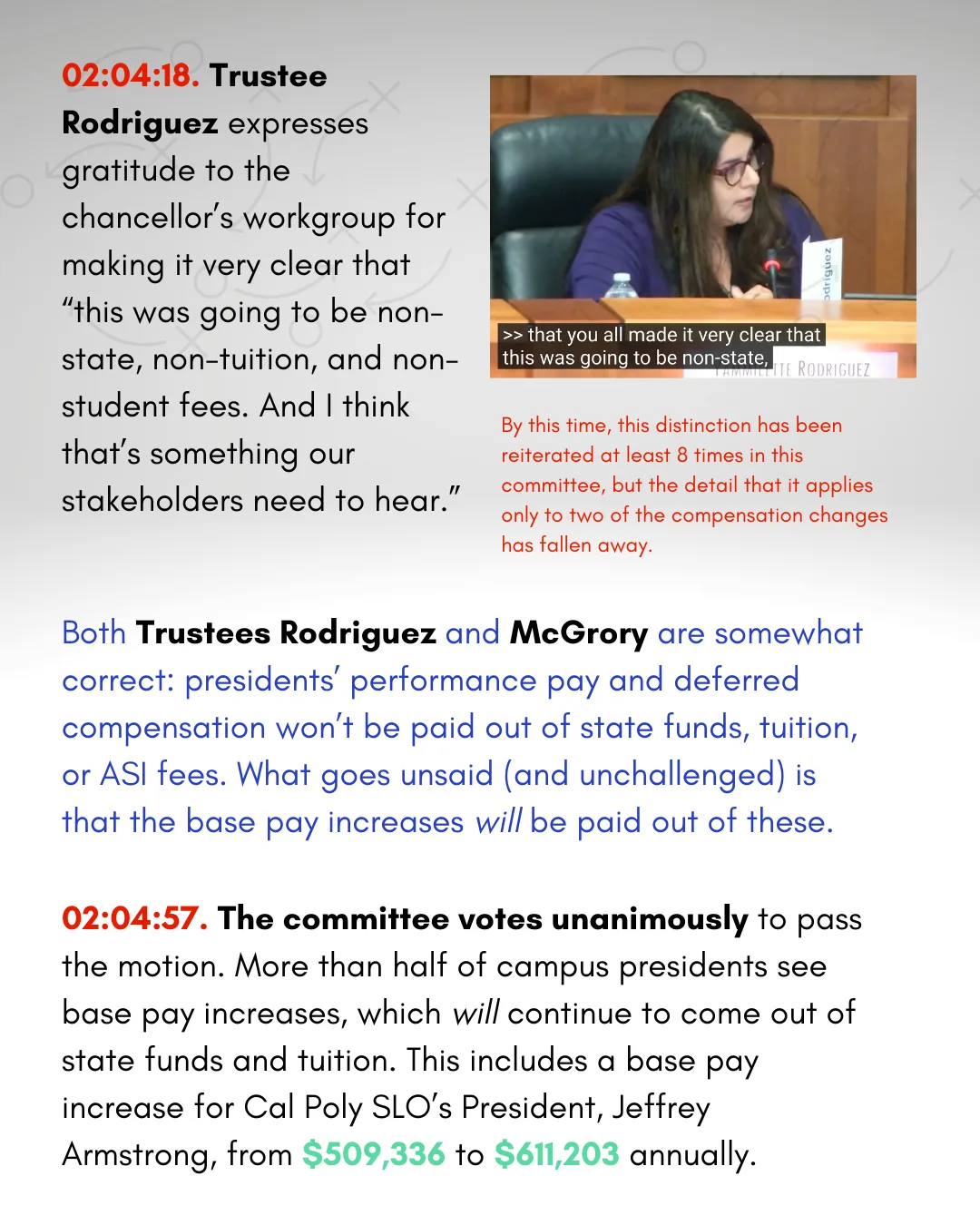
When the chancellor’s recommendations were nearly approved, Trustee McGrory remarked that everybody “but the students and the state” will pay for these new policies, making them more “palatable” to everyone. Trustee Rodriguez followed up by thanking the chancellor’s workgroup for making it very clear that the chancellor’s recommendations, including base salary increases, were going to be non-state, non-tuition, and non-student fees. However, this is a misunderstanding.
Without further examination, all board members voted to pass the motion except for Lieutenant Governor Eleni Kounalakis.
These aren’t half-truths; they’re lies by omission, plain and simple. Despite the emphasis on the policy having nothing to do with students or the state, more than half of campus presidents will now see their base pay increase as a direct result of student tuition and state funds!
“After including these bonuses, the compensation increase can go up to 38% in some cases,” said Malladi. This includes an annual base pay increase for Cal Poly San Luis Obispo’s president, Jeffrey Armstrong, from $509,336 to $611,203. “Public sector compensation systems normally align with increases with the financial condition of the organization. When budgets are shrinking, the logic of approving large increases in the backdrop of multi-round budget cuts and layoffs requires clear explanation.”
Malladi also notes something suspicious about management using recruitment and retention of highly qualified leaders as justification for higher pay. “Giving pay hikes to executives who are retiring in a few weeks is not what one would call recruitment or retention. Additional rationale here would help the public understand how these decisions are made about pay hikes to executives in general, which are pushing the compensation of CSU executives.” CSU Dominguez Hills president, Thomas Parham, will retire in less than a few weeks. However, he was still given a raise from $453,971 to $476,670.
We would do well to remember that this is not simply an issue of pay raises; what we’re witnessing is a series of systemic failures that do not align with the core values of the CSU.
While this is upsetting to read, let us remember that our university jobs won’t organize for us, and that Chancellor García and the Board of Trustees have neither our interests nor our students’ interests at heart. This is why it is critical we come together as CFA members to hold CSU management accountable. Stay tuned for more upcoming actions in the Spring!
Join California Faculty Association
Join thousands of instructional faculty, librarians, counselors, and coaches to protect academic freedom, faculty rights, safe workplaces, higher education, student learning, and fight for racial and social justice.