
Safety Beyond Policing
In July 2026, a CalMatters investigation drew sharp attention to campus police when they learned that many CSU and University of California (UC) campuses either carried significant amounts of military-grade equipment or omitted to list them in their reports.
Since 2017, CFA members and Students for Quality Education (SQE) interns have been calling for reimagining campus safety by first and foremost ending militarizing policing on our campuses. We believe the presence of militarized police on our campuses is antithetical to fostering a sense of community and trust through education, transformation, and advocacy for racially and socially just campuses.
Numerous facts were uncovered from this investigation, but two were particularly noteworthy.
First, many campuses failed to include reports or policies that contain details mandated by state law regarding the funding, acquisition, and use of military equipment. As noted in the CalMatters report, many campuses left out information, including manufacturers’ product descriptions, up-to-date inventories and equipment quantities.
Second, without the knowledge of campus members, state legislators, or local communities, campus police have stockpiled hundreds of semi-automatic rifles and hundreds of thousands of rifle munitions on our campuses.
This leads us to wonder: What role do campus police officers actually serve, and does their presence on our campuses actually align with the mission of the CSU?
The CSU states that the police department is “charged with maintaining a safe campus environment by enforcing federal and state laws, CSU regulations, and the establishment of crime deterrence and prevention-related programs.” But across CSU campuses, the majority of campus police work does not actually have anything to do with safety, as more than half of police encounters involve traffic or parking issues. For example, at CSU Los Angeles, CSU Northridge, CSU San Marcos, and Fresno State, more than 60% of police stops at each campus were for alleged traffic violations.
More importantly, law enforcement across the country is responsible for producing widespread violence and daily harm across racial, gender, and socioeconomic lines because of unconscious racial and social biases as well as training curricula designed to prepare them for perceived threats using both legal and tactical firearms. Should we believe that campus police, who hold matching biases and receive the same training as municipal or local policer officers—can somehow be insulated from that same behavior?
It doesn’t appear so. Although some may equate campus police with campus safety, the evidence points to the contrary. In reality, campus police represent campus danger, not safety, for many of the students and faculty who have been surveilled, harassed, humiliated, stalked, and criminalized by them.
Despite the increase of police presence on campus, the overall number of on-campus criminal incidents has failed to produce a consistent trend. This begs the question: Why has police presence increased even when the crime rate has not grown?
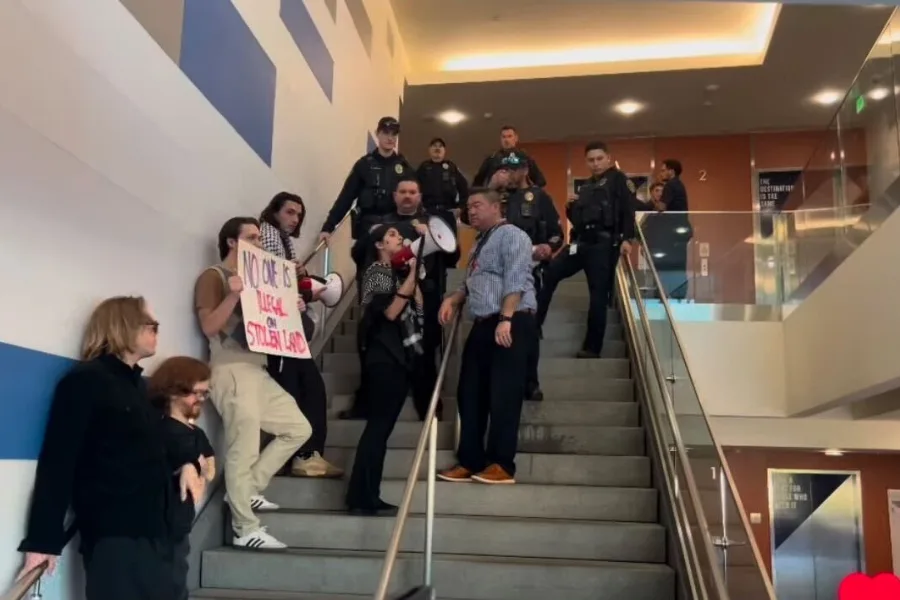
Historically, police have been called to suppress protestors like they did during the Vietnam War and civil rights movements. Now, we are witnessing this same infringement on freedom of speech during anti-ICE protests, Free Palestine encampments, Black Lives Matter rallies, and other public demonstrations calling for the protection of human rights and calling out state-sponsored oppression and militarized policing. But the police response to these demonstrations is rarely, if ever, the solution.
The contrast could not be more different when we examine the actions of two CSU presidents, which ultimately led to drastically different outcomes. In April 2024, Sacramento State President Luke Wood de-escalated pro-Palestinian student encampments through open dialogue, active listening, and a willingness to implement a new socially responsible investment policy rather than coerce students to evacuate through the use of police force. That same month, former Cal Poly Humboldt President Tom Jackson Jr. bussed in roughly 100 militarized police officers with riot gear to quash campus protests, which led to the shutdown of the campus for the remainder of the semester and the arrest of 31 individuals.
It is difficult to equate campus policing with campus safety, especially when militarized police represent danger and escalate tensions. While it may be tempting to reimagine policing, history has shown that the system is working exactly as it was intended, which is to protect those in power, maintain the status quo, and reinforce race and class control.
We must continue finding ways to address patterns of behavior that disproportionately affect Black communities and other historically disadvantaged communities. We look forward to hearing and sharing different perspectives from our campus members on how we can foster a sense of safety that goes beyond policing.
Join California Faculty Association
Join thousands of instructional faculty, librarians, counselors, and coaches to protect academic freedom, faculty rights, safe workplaces, higher education, student learning, and fight for racial and social justice.