
Equity Conference Closes with a Message of Joy and Resistance
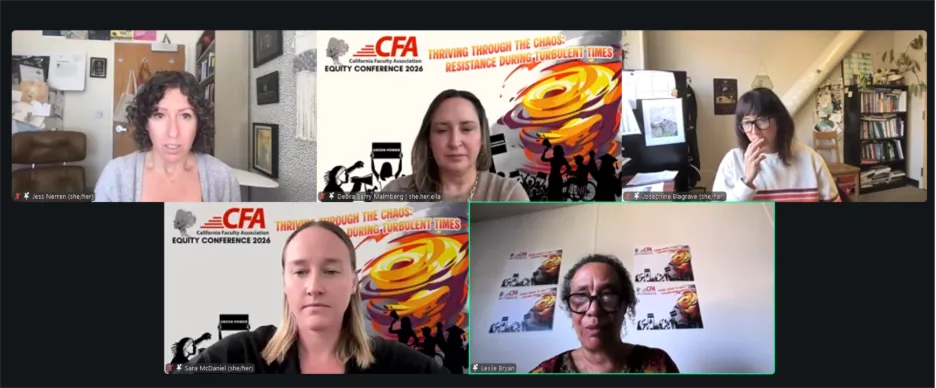
Coursing through the veins of every keynote presentation, panelist discussion, and informative workshop at this year’s Equity Conference was the theme: “Thriving Through the Chaos: Resistance During Turbulent Times.”
“This was a gift for us as organizers,” said CFA Palestine, Arab, and Muslim (PAM) Caucus co-chair Rabab Abdulhadi and San Francisco State professor. “There was so much food for thought. We really need to do this all the time so we are reminded of why we do what we do. We support each other and have love for each other, even if we disagree.”
Kaitlin Reed and Cutcha Risling Baldy, CFA members and Cal Poly Humboldt professors, spoke about their work as co-directors on the student-led and community-driven project: the Rou Dalagurr Food Sovereignty Lab and Traditional Ecological Knowledges Institute. The food lab is California’s first dedicated space for cultivating Indigenous Knowledges in a university setting.
“As part of the settler-colonial violence enacted through California, our traditional foods are very much targeted as a site of violence,” said Reed. “We really do think about our traditional foods not as natural resource that exist through the monetary accumulation of human beings, but that we exist in a relationship with those traditional foods. The functionality of that relationship is an important indicator of—not only the environmental health of our communities—but the social health of our communities as well.”
She expressed that carving out Indigenous spaces on campus serves as an act of resistance and helps to further develop students’ knowledge.
The lab carried out a three-year research project with Native students centered around why their work matters. Their response after working at the lab was this: “We will save the world with acorns, salmons, and seaweed.” This conviction has become the basis for much of the lab’s ongoing work.
Fighting antisemitism while building solidarity
In their panelist discussion on detangling antisemitism, Barry Trachtenberg, chair Jewish History at Wake Forest University, explained that the term “antisemitism” has undergone a profound transformation that has moved it away from its core focus on what he specifies as “anti-Jewish hatred” to a vague one that has become increasingly weaponized in our political discourse.
“Antisemitism has, as a deliberate strategy, become so elastic and evacuated of its original meaning that it now obscures more than it clarifies,” said Trachtenberg. “Today, accusations of antisemitism are frequently deployed not to identify anti-Jewish hatred, but to regulate our political speech.” Trachtenberg noted that the term has become so unstable and broadly defined that it is used to describe both violent neo-Nazi attacks and principled opposition to Israel’s ongoing genocide of Palestinians.
Shane Burley, who authored the book, “Safety Through Solidarity: A Radical guide to Fighting Antisemitism,” argued that antisemitism is not functionally different than other forms of oppression and that it should not be fought on its own.
“The truth is that history teaches us something different about Jewish safety and Jewish lives and about who is marginalized alongside Jews in all situations,” Burley said. “[Antisemitism] comes with anti-immigration xenophobia, transphobic theories of medicine, and attacks on abortion rights. These things are integrated and we experience them together. The only solution to fighting back is doing it together. We must create unified structures across differences to organize in our communities and to go after the very systems that created that inequality.”
Gender justice matters in a time of transphobic attacks
CFA members Lori Baralt, Tomomi Kinukawa, and Loren Cannon shared their experiences on how Women’s, Gender, and Sexuality Studies (WGSS) programs are being attacked across the nation, intertwined with attacks on academic freedom.
Baralt, a CSU Long Beach professor, emphasized how crucial WGSS is for dismantling unjust systems of oppression that subjugate and exploit others for the benefit of the most privileged in society. Baralt asserts that educators are viewed as a threat to those in power because of the role they play in teaching and exposing the next generation to the idea of power structures and how they are maintained.
Kinukawa, a San Francisco State lecturer, explained how white supremacist colonial feminism has both attempted to silence racialized and gendered others and dominate academic spaces, including the repression of WGSS.
Cannon, CFA secretary and Cal Poly Humboldt lecturer, suggested ways we can confront the attacks on gender identity. “There are two antidotes,” he said. “One is community. Another is to recognize that trans people of all nationalities, ethnicities, races, abilities, have always existed, and that we have stories of resistance and resilience. In this chaotic time, I do see an opportunity to build a society that we can live in that’s not about constant competition and policing of gender.”
Disability justice helps build a CSU for all
A panel on disability justice discussed strategies for empowering faculty to further disability inclusion. The speakers helped frame the issues around the physical, structural, and institutional barriers that many people face.
Sarah McDaniel, CFA member and CSU East Bay professor, described how disability justice is a vehicle for examining broader systems of power, race, class, gender, and other constructs. “The idea of disability justice pushes us to rethink institutions, who they’re built for, whose knowledge and experience are valued, and question that, and make sure that we are leading with this idea that disabled people deserve to exist in all spaces,” said McDaniel.
Liberating the CSU through liberatory education
In her talk, “Deep Unlearning: Liberatory Education from Platitudes to Praxis,” keynote speaker Ruha Benjamin, a sociologist and professor at Princeton University, invited us to consider what we must unlearn when it comes to liberatory education. She challenged the idea that intelligence should be identified with smartness, innovation with social progress, technology as self-propelled, deep learning as statistical, and power as subjugation (power over others rather than with others). Instead, Benjamin identified these the origin of these terms are often derived from ableist, racist, sexist, classist, and colonialist hierarchies devoid of empathy and ethics.
“What about horizontal power, collective, shared, relational?” said Benjamin. “What about love as the most powerful force imaginable? It is such a threat that it has to be constantly diminished, commercialized, romanticized, feminized, made sparkly and sweet, so that we don’t take it too seriously, so that it never manages to take hold of our collective imagination.”
The importance of abolition in times of political repression
Journalist Thandisizwe Chimurenga spoke about how the federal government hides under the guise of legality, such that whatever is done in opposition is deemed illegal. When movements and activists actively oppose their government’s oppressive policies, either through writing, speaking, or organizing, they become political prisoners. Yet the only crime they have committed is actively opposing their government.
“The entire civil rights movement was illegal,” says Chimurenga. “All those that we consider our heroes were breaking the law. Just because something is lawful doesn’t mean it’s right. What we must consider is whether an action is done for the good of humanity or for the good of a few.”
But Chimurenga reminded us that the important element in our struggle was thriving through the chaos. “Joy is very important. We’re not just talking about civil rights or legality. We have to have joy. You have to take time for yourself. It is not just good for your mental and emotional health. It is a form of defiance… a form of resistance. Seek out your joy and guard it fiercely,” she said.
Several workshops explored various aspects of organizing, including immigration advocacy, tips for countering doxxing, developing legislative bills, understanding the origin and development of CFA’s Interruption Practice Statement, and crafting compelling messages around key issues.
Solidarity in and outside of the CSU
Organizer and activist Ash-Lee Woodard Henderson closed out her talk by amplifying the need to build solidarity with our own union members as well as other disenfranchised workers and community members.
She reminded us that by embodying anti-racism inside our union structure, we made CFA even more powerful. “You pushed SEIU (Service Employees International Union) to go further, not be more conservative. Your Shortchanging Students report, your sanctuary union position, your EEOC lawsuit came out of your ARSJ transformation,” Woodard Henderson said. “You model what you say rather than just talk about it.”
Woodard Henderson left us with a powerful reminder: “This fight that we’re in at this political moment is the fight of our lifetime. Legacy will be built or crumble under the decisions we make right now. That puts a certain level of urgency on our fight, but not all of it can be a sprint. So, what should we do? We should be building relationships.”
What has been shared here is only a small glimpse of many of the great panelists and keynote speakers that were featured during the virtual conference. Many of their sessions will be recorded and available in the near future on our Equity Conference webpage.
Join California Faculty Association
Join thousands of instructional faculty, librarians, counselors, and coaches to protect academic freedom, faculty rights, safe workplaces, higher education, student learning, and fight for racial and social justice.