
Summer Bargaining Continues, What You Need to Know About Our Bargaining Proposal on “Order of Assignment”
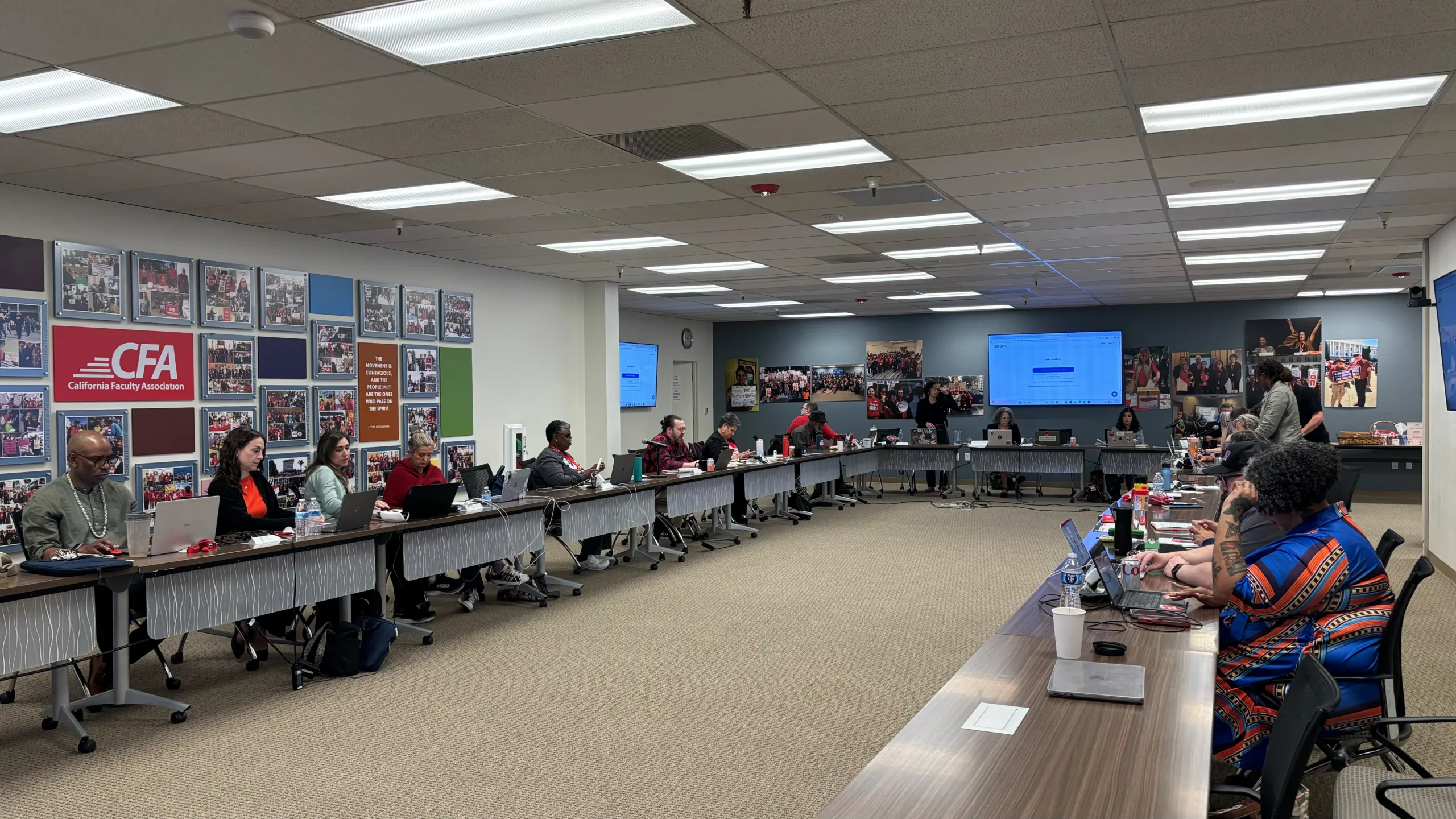
As we are near the end of the academic year, our bargaining sessions with CSU management continue on through the summer! Here’s how and why you can stay up to date to ensure that we win a fair contract: 1) check out headlines; 2) attend bargaining updates when possible, and 3) because this information allows us to stay up to date so that we can organize, build unity and power, cultivate a stronger understanding of our rights, and escalate if and when we must.
Last week, we broke down our ten proposals on appointment, one of which focuses on changes to assignment order and how available work, like course assignments, will be distributed.
This “Order of Assignment” proposal, applies to all faculty, but it’s particularly important to lecturer faculty as it guides who receives offers of work, how many units those offers will be, and all within the context of an order of assignment.
Currently, the order of assignment prioritizes work for tenure-line faculty, and then 3-year lecturers, followed by 1-year lecturers and semester to semester lecturers. However, the way this appointment process works, lecturers are routinely locked into part-time temporary assignments, making it almost impossible for them to get enough new and additional work to move into full-time unconditional status (a designation that gives lecturers the most job security). So we are proposing modifications to the order of assignment to build in rights for seniority and to prioritize bringing existing lecturers up to full-time before new lower time base lecturers can be hired.
We are proposing that work shall now be first offered based on the seniority of faculty with temporary appointments, which is defined as the date they were hired in their department (or any prior departments that have ceased to exist as a result of being merged or dissolved).
Additionally, we are proposing the work must be offered to qualified faculty and in the following order:
- Three-year and five-year part-time appointees
- Those with three-year appointments whose names appear on the departmental list (see Article 38.48)
- One-year full-time appointees who were first appointed to their department by Fall 2025
- One-year part-time appointees who were first appointed to their department by Fall 2025, up to their time base entitlement
- Additional work for part-time three-year or five-year appointees up to a 1.0 time base
- Continuing multi-year full-time appointees
- Continuing one-year full-time appointees who were first appointed to their department after Fall 2025
- Continuing one-year appointees who were first appointed to their department after Fall 2025 and multi-year part-time appointees up to their time base entitlement
- Visiting faculty
- Part-time and full-time temporary faculty with no multi-year or long-time appointments who were employed in the current or prior academic year and are not eligible for a 12.3 entitlement
- Administrators, teaching associates, and other student employees
- Part-time temporary faculty who have a one-year appointment up to a 1.0 time base
- Any qualified candidate, including potential new hires
We passed this version last week, but management has rejected nearly every previous version of CFA proposals on Article 12; this included our proposals to bring more job security to lecturers who continue to be negatively impacted by precarious employment.
Our union’s goal is to ensure fairness while improving the stability and working conditions of our faculty. But to win strong contracts, we need strong engagement from our members.
As bargaining continues over the summer, we encourage all CFA members to talk with their colleagues and departments about our current proposals on the table. Remember: every campus has an elected bargaining team member at the table, representing you so don’t hesitate to reach out to them for questions, comments or suggestions. Look here for Your Bargaining Representative.
If you know of any faculty members who are not yet members, encourage them to join us in this fight! Also, reach out to your field representative or chapter president for more ways to get involved. You are always welcome.
This work will take all of us, but we win when workers stick together to demand fairness in the workplace!
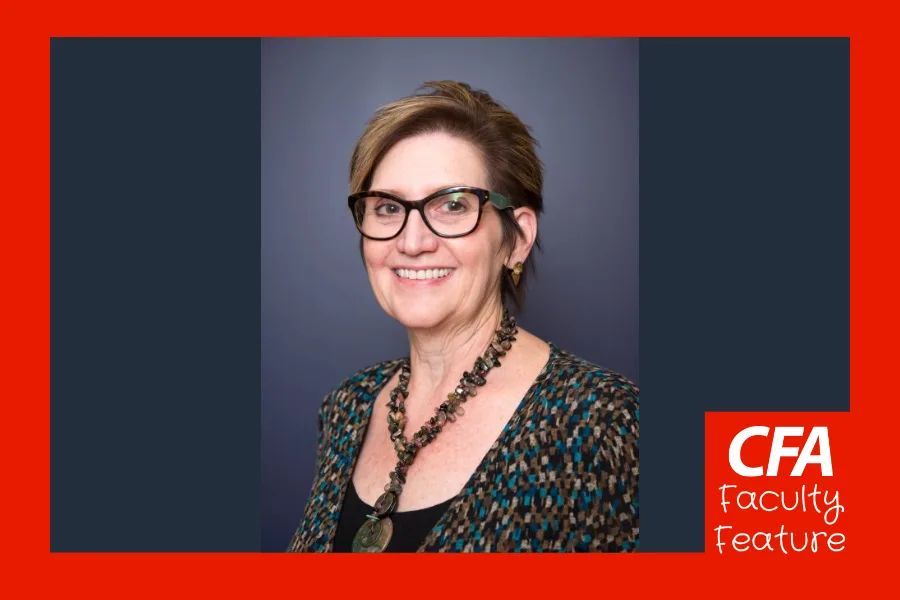
When Nancy Meyer-Adams walked into her classroom at the University of Southern California (USC) two decades ago, she overheard students groaning about the day’s topic: teen pregnancy. One of the students muttered there was little point in discussing teen moms since their futures were incredibly bleak.
Instead of proceeding with her planned lecture, Meyer-Adams shared a story. She described a 16-year-old musician checking into rehab just days before Christmas for drug and alcohol abuse. His parents—a mother employed as a waitress and bartender and also a high school dropout, and a father employed as a nurse—had him at 17, and his sister at 16.
Meyer-Adams then told them they all knew one person in the story, then asked them to imagine where that family might be today. While most students predicted a dismal future for the family, others guessed that the son had become a famous musician. The twist, however, was that the person they knew wasn’t the son, but the mother—Meyer-Adams herself.

Today, Meyer-Adams leads the School of Social Work at CSU Long Beach (CSULB), while her son is a full professor of psychology at Colorado State University, and her daughter is a licensed clinical social worker and acupuncturist. Under her leadership, the School of Social Work has expanded to 60 faculty members, 650 graduate students (MSWs), 150 undergraduate students, and nearly a dozen staff members. 232 MSWs are graduating on May 19 and will be ready to join the California workforce.
“I tell this story because you never know the people that you will touch as social workers,” she explains to her students. “A lot of times, you only hear the bad… that these kinds of families fail. I don’t have to share my story with my students, but it’s important for them to listen to the people whom they will be working with as social workers, to understand their stories, where they come from, and what they are facing.”
Now concluding her final few months of her 12-year tenure as the school’s director, Meyer-Adams is eager to get back into the classroom.
“A lot has happened during this time,” she said. “COVID-19, the murder of George Floyd, the Trump administration, ICE raids and murders… so many things I would never have imagined myself having to lead through.” And while it has been a challenging learning experience for Meyer-Adams, she said that she has no regrets and has loved doing the work for over a decade.
Despite having significant academic responsibilities, Meyer-Adams stepped away in Fall 2025 when she learned her daughter was diagnosed with breast cancer. She spent that semester in Florida to be with her.
Meyer-Adams’ path to academia is atypical yet extraordinary. In 1971, she fell in love as a teenager in Indianapolis, became pregnant at age 16, and was forced to drop out of school. At that time, there were no programs for teen moms to continue their education.
By age 20, she was raising her two children as a single parent, working long hours in the restaurant business as a waitress, bartender, and eventually a manager. Things got more difficult when her son entered rehab. During this time, Meyer-Adams had her first encounter with social workers, who provided therapy for the family members and offered other means of support for her son. Unbeknownst to her, their meetings would have a profound influence on the trajectory of her and her children’s careers later on.
Realizing her job in the restaurant business was unsustainable, Meyer-Adams went back to school. She earned her GED at age 37 and then enrolled at a local community college. There, she met an instructor who encouraged her to push herself further academically. Meyer-Adams was accepted into the Honors Program and developed a strong interest in social work and social justice.
Scholarships helped pave the way for her bachelor’s and master’s degrees at Florida International University. There, she was mentored in ways she could not have imagined and by professors who saw something in her that she couldn’t. She also had a transformative experience while studying abroad in Spain.
One milestone after another, Meyer-Adams eventually found herself with a PhD from the University of Tennessee at the same time that her son received his PhD from UCLA. In just ten years, she went from a GED to a PhD.
“I was so inspired by my mentors—the people who saw something in me,” she said. “I would have never dreamed that I would get my GED, let alone go on to earn a PhD!”
Although she has not taught a course since 2014, her study abroad experience inspired her to develop a similar experience for social work students, including an undergraduate exchange program with the University of Hamburg – Applied Sciences (HAW).
“We were able to figure out how students could actually do their practicum in Hamburg despite a language barrier, as the social work students usually do not speak German,” she said. “And, since 2018, students have been able to work in refugee centers, services for the unhoused, and with other vulnerable populations while studying at HAW.”
She also created a shorter two-week summer study abroad course for graduate students in Berlin and Hamburg, where they focus on social justice and human rights. The summer of 2026 will be the fourth cohort in this program.
“We then sit and talk about their experiences,” Meyer-Adams said. “It’s these moments when I see them shift their perspective in powerful ways. There’s nothing better than this.”
Her advocacy goes beyond just her family and students. As a strong supporter of unions, she credits CFA with helping to improve the working conditions for all CSU faculty.
“Before this job at Long Beach State, I was never protected by a union,” she stated. “I never had medical insurance, pension, or any of the other benefits I currently have. I joined the day I walked onto the campus because I was so thrilled to be able to have that kind of support at my job. Unions help people, and it really shows.” She sees this at CSULB and with many of the clients her students work with outside the university.
Recognizing her own power as a CFA member, she pushed for better treatment and compensation for lecturers when she became the school’s director in 2014. She learned they were not receiving equitable pay and worked diligently to address concerns regarding salary compression and range elevation.
“Many times, lecturers carry the brunt of the work each semester in the classroom,” Meyer-Adams said. “It’s important they feel valued and feel good about coming to work.”
Her advocacy led to significant changes in lecturer working conditions and, throughout her tenure, she has continued to encourage more lecturer participation in the School of Social Work. Lecturers now hold positions on every committee within the school and can vote on curriculum and other items within the School of Social Work.
At the same time, Meyer-Adams also recognizes that union advocacy can mean compromises, and that not every fight will benefit her.
“Our members are doing exactly what they should be doing by going to their union representatives when needed,” she said. “Even when it doesn’t directly serve me, CFA members are ultimately out there fighting for all of us.”
For that reason, she is incredibly proud to be a CFA member.
“I feel great when I see other members here in the school. We all have CFA buttons, signs, and stickers on our doors. We walk the picket lines together and it just adds to the feeling of this being a great place to work. It’s great that I can collect a pension when I retire. That wouldn’t have even been a thought in my head twenty-five years ago. That’s because of our members and our Collective Bargaining Agreement.”
Looking back, one of her greatest achievements has been cultivating faculty that reflects the diversity of the students in the School of Social Work.
“It’s a dream come true for me and it makes me emotional,” she said, referring to the times students tell her that they see themselves in their faculty. We have such a rich mix of faculty in the kinds of ways that make us feel like we’re representative of what we say we’re supposed to be as social workers, and our students feel like they have faculty they can relate to. Knowing the importance of how mentors changed my life, I want to be sure our students can make connections to our faculty mentors”.
Meyer-Adams completes her role as director on August 14, just as she nears 72 years of age. She will spend the fall semester with her daughter to aid in her recovery from surgery before returning to teach in Spring 2027, where she will continue to share her personal story about teen pregnancy and dropping out of high school with incoming students.
“My son, my daughter and I, we made it out,” she exhaled. “It was a long haul with lots of bumps in the journey, but we did it… we beat the odds.”
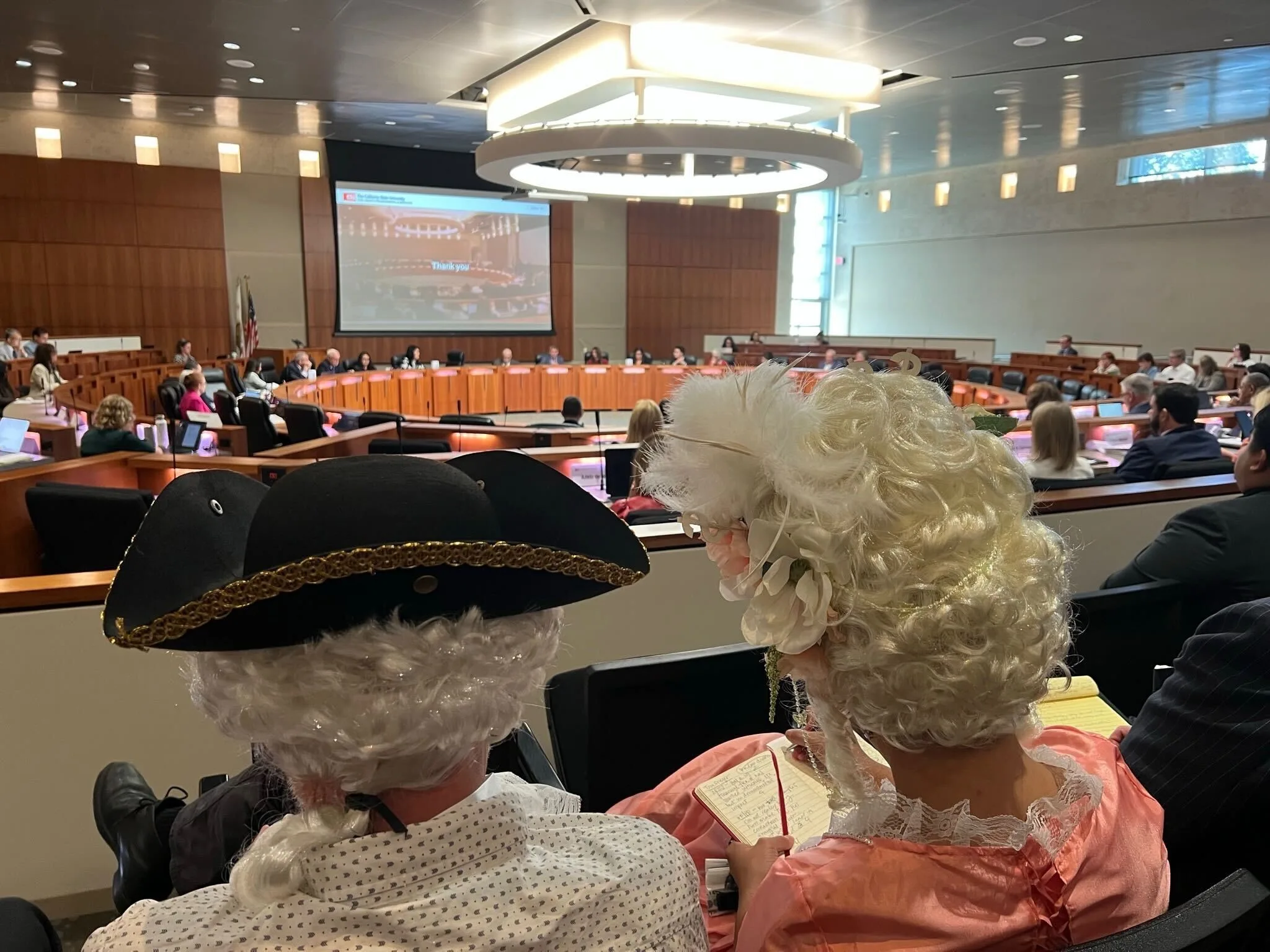
CFA members mobilized at the May 4-6 CSU Board of Trustee meetings, showing executives we will fight for our bargaining proposals and against austerity measures.
Elaine Bernal, CFA Associate Vice President of Lecturers, South, reprised their role as Millie Antoinette, comparing Chancellor Mildred García to Marie Antoinette, the former queen of France. Marie Antoinette was known for her courtly extravagance and obliviousness of poverty and duress caused by her political misspending during the French Revolution—an apt metaphor for faculty anger about current CSU budget issues. In addition to approving increases to executive salaries while issuing layoff notices, García has amassed a pile of unfair practice charges since she became chancellor.
Millie Antoinette sat in the board chambers to observe the meeting, startling the trustees with their rococo-style pink dress and tall wig. After the meeting, they gave a report out of the board’s actions.
During the board meeting, trustees approved compensation for the new Interim Vice Chancellor of Human Resources, Dave Grant. Effective retroactively to April 17, Grant makes $378,000 annually and a car allowance of $12,000 per year. The former Vice Chancellor of Human Resources, Frank Hurtarte made $374,400 annually with $61,244 in deferred compensation.
In public comments, CFA members spoke up about issues including mismanagement, bargaining proposals, and the targeting of Black students at CSU Northridge.
“You come here every few months and talk about spending hundreds of thousands of dollars on a new executive or millions on a new building,” CFA president and Sacramento State professor Margarita Berta-Ávila. “You pat yourselves on the back for raising tuition and making so-called hard choices, honestly perpetuating the narrative that at the core is mismanagement of funds and manufactured debt. But do you know that you are currently sanctioning the blatant targeting of Black and Brown students at Northridge by CSU Northridge Police?”
Campus police have arrested six students this academic year. Three of those arrested are Black students, and the non-Black students’ arrests stemmed from their activism on campus. Along with the Hands Off Students campaign at CSU Northridge, CFA members have been calling on the university administration to align its practices with its values and to meet the coalition’s demands to eliminate anti-Black and anti-student policing.
Molly Talcott, CFA representation committee chair and CSU Los Angeles professor, spoke on bargaining proposals in her public comment.
“Faculty working conditions are student learning conditions,” Talcott said. “The CSU continues to disinvest in both and this harms our students. CFA’s bargaining proposals address this harm. We propose that bosses cannot increase class size by fiat as they did at LA where they said, ‘assign less and assess students more efficiently.’ But we refuse to cheat our students of an education.”
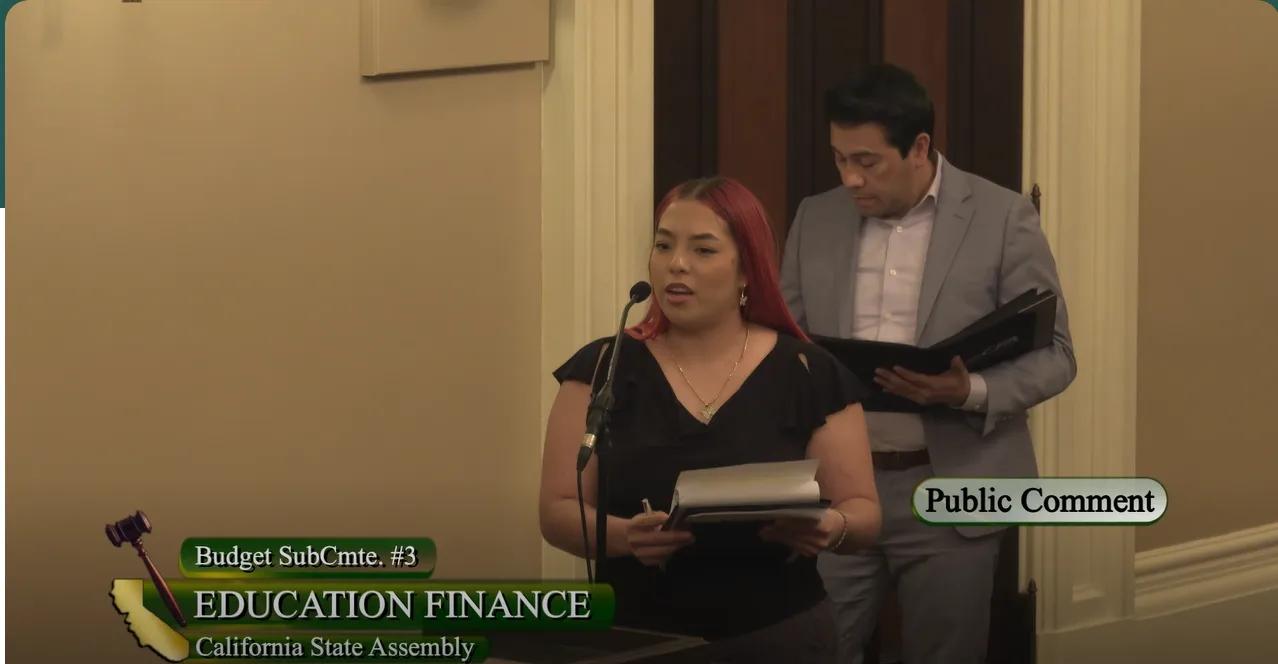
CFA members continued their vigilance and advocacy around state funding for the CSU at an Assembly Budget Subcommittee hearing on April 29.
CSU executives told the committee about their plans to reallocate funding from campuses with lower enrollment to campuses with higher enrollment. They also explained a request for one-time funding to help with enrollment and health care workforce programs.
For budget year 2026-27, the CSU plans to move $26 million from five campuses to 12 campuses, said CSU Assistant Vice Chancellor Mark Martin. Martin did not name the five nor 12 campuses.
CSU management began moving funding away from campuses below their enrollment targets to campuses above their enrollment targets in 2024-2025, according to the Legislative Analyst’s Office (LAO). Campuses above their targets that year were Northridge, Long Beach, Sacramento, San Jose, Monterey Bay, San Diego, Fullerton, San Luis Obispo, San Marcos, and Pomona. Campuses below the target were Sonoma, Maritime Academy, Channel Islands, Humboldt, East Bay, San Francisco, Chico, San Bernardino, Dominguez Hills, Stanislaus, Los Angeles, Fresno, and Bakerfield, according to the LAO.
CFA opposes the redistribution of funding from campuses who have fallen short of meeting enrollment goals to campuses that have surpassed their enrollment goals because this impacts the ability of underenrolled campuses to rebound. Also, the redistribution of funds does not take into account that costs per pupil will be different at each campus.
Students for Quality Education (SQE) CSU East Bay intern Kenia Juarez urged the subcommittee to oppose the reallocation of funding because it hurts campuses’ ability to grow.
“On my campus, there has been programs that have been cut because of the lack of enrollment, which also stops the support that students get already, which is cutting the amount of students that they accept into these programs, which only hurts our university even more because of the funding,” Juarez said. “Unlike larger CSU campuses, smaller campuses do not benefit from these economies of scale. Even modest enrollment loss causes significant campus destabilization that can include the layoff of faculty and staff.”
CFA members will continue to keep a close eye on CSU funding before and after Governor Gavin Newsom’s May Revise, which will be released by May 14.
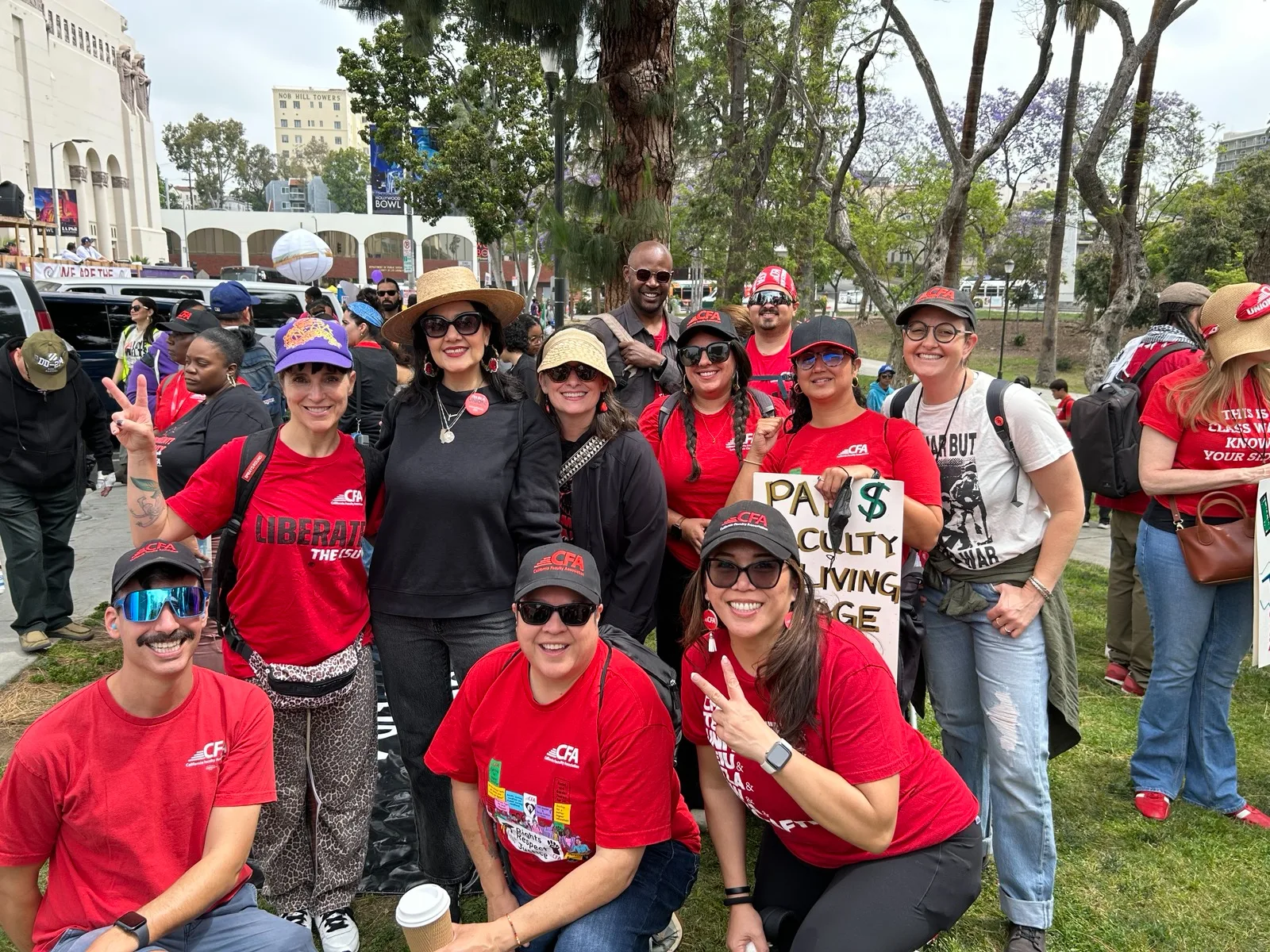
CFA members rallied and marched across the state on May Day, also known as International Workers Day, in a show of solidarity.
International Workers Day celebrates workers and the history of labor organizing. Many actions also involved demonstrations for immigrant rights and social justice.
In the Los Angeles area, six CFA chapters joined together to march as a bloc of over 50 faculty, with the banner “Higher Education for Labor,” chanting for nearly 3 miles, from Mac Arthur Park to Grand Park. The theme, “Solo El Pueblo, We Shut it Down,” was chosen by a coalition of immigrant rights organizations and labor unions. The coalition included CFA and Council for Racial and Social Justice leaders, like Alejandro Villapando. At the rally, John Caravello also spoke to a crowd of thousands, echoing the message to join and strengthen labor union organizing for immigrant defense.
Below is a transcription of a speech CFA president and Sacramento State professor Margarita Berta-Ávila gave at a May Day action in Sacramento.
“My name is Margarita Berta-Ávila. I am a professor of education at Sacramento State and the first Chicana President of the California Faculty Association (CFA), a union of 29,000 professors, lecturers, librarians, counselors, and coaches who fighting for an accessible, safe and equitable education to the California State University (CSU) system’s 485,000 students in all 23 campuses.
We, as CFA, are here today in solidarity on this May 1, International Workers Day, demanding that ICE be abolished, demanding the release of our siblings that have been abducted with unjust detentions, and that ICE return our community members to their families and end the horrific act of family separations. These demands are stated in solidarity as labor, workers, and collective community with one another but specifically uplifting the fight we have together in protecting our immigrant communities.
With this collective demand – we are resisting and answering the call to organize for the future we envision and deserve. For we are all part of a labor movement—a people’s movement—that must be on the front line, because our communities, our families, are not human collateral, nor will we allow them to be!
With that said, for all of us to be gathered here today is no coincidence. May 1, International Workers Day, serves as a day of solidarity for workers to advocate for labor rights, better working conditions, and social justice. Justice for one another.
It’s not lost on me that today is also the 20-year anniversary in which millions of immigrants and co-conspirators in the United States participated in “A Day Without an Immigrant” (or El Gran Paro Estadounidense). The date was chosen specifically to coincide with May Day, reviving its historical roots as a labor-focused, radical day of action in the U.S.
Demonstrators boycotted school, work, and shopping to highlight the economic contributions of undocumented laborers. Hundreds of thousands marched in cities like Chicago and Los Angeles. But let’s not forget that here, in Sacramento, we came out and took care of business. With the purpose of opposing HR 4437 which proposed making undocumented presence a felony.
Twenty years later, even more so, it is about rights, respect, and justice for hardworking people and their loved ones. It’s about justice for our students on our CSU campuses living with constant uncertainty: if today will be the day they are deported. Will it happen on campus, or will anyone stand up for them? Fear of not knowing how they take care of themselves as well as their family.
It’s about our students putting themselves on the line to protect their fellow students and communities and are getting arrested, especially Black and Brown students being targeted, like at CSU Northridge. It’s about the folk who are observing in the courtrooms, the folk that are accompanying, the folk taking food to families who are afraid to leave their homes, the folk fixing the brake lights so people are not fearful to be stopped by the police if they are undocumented, the folk organizing the community watches, the folk on the threads with the rapid responses, its about the rights, respect, and justice for all those who have been killed.
So, when we say, “We take care of us, EI Pueblo Salva el Pueblo!!!,” these are not empty words. These are words that we are giving life to and have a responsibility, one way or another, to do something about. Let me pause here for a moment, for this statement – we take care of us – is a call for each of us to embody mind, spirit, and body. That is why the preparation of my words today has been emotional for me. Because of the urgency of our role as a community, as a colectiva, we must continue to meet the moment in the movement that we are in. There is no time to waste or even get caught up in our egos or what we alone think must happen.
With the heightened fascist rhetoric and actions taken at the federal level that are impacting us here today, right now, there are no words to properly describe what is being felt and experienced. But what we do know is this – we are committed to this movement – to make known to all, that as a movement we are demanding the necessary humanity to live a quality of life – free from fear, harassment, and hostility. We will not stand for Trump’s or Congress’ or the Heritage Foundation’s – and anyone else we can name – racist, xenophobic, fear mongering, sexist, toxic masculinity, misogynist, anti-LGBTQ and transphobic actions and policies.
As CFA, and part of a larger labor coalition, we recognize that being part of this labor movement is a people’s movement. Pushing back on these fascist actions and being at the forefront of justice, equity, and access is not an option. Thus, the realities of our communities and families of our students cannot be ignored, whether it be fighting for safety because of immigration status, a living wage, health care, affordable housing, food security, or because you are a woman or person of color.
As a colectiva – there will be those moments of disagreements regarding the approaches taken. That is OK. It does not mean we are now enemies. You might be saying to yourself, ‘That is obvious. Of course there will be differences of opinion.’ But I am saying it because it is worth repeating today. It’s about rolling your sleeves and getting to work simultaneously. What must be expected of one another is a level of political maturity. A collectivist understanding that right now, this fascist, imperialist government is counting on us to fight and tear each other down.
I am going to say this: we have a moral responsibility to be concientes (aware) that we cannot fall into that trap. For this fight is far from over.
In my early 20’s, an elder in the Sacramento native and indigenous community, Mama Cobb, shared with me the following: When we transition to the sixth sun, it will come with chaos, destruction, harm, pain, etc., but those who can come together collectively and think of each other and the betterment of one another will see the other side of it. Those who are individualistic and are working to only further their own name/agenda will not survive.
How you want to interpret this message is up to you. But one thing is clear: we organize for what we envision. We are here to concretize the possibilities collectively, to organize collectively, to remember each other’s humanity in our work. It is inspiring to see working people exercising our right to speak out and organize and making it clear that we are not going anywhere.”
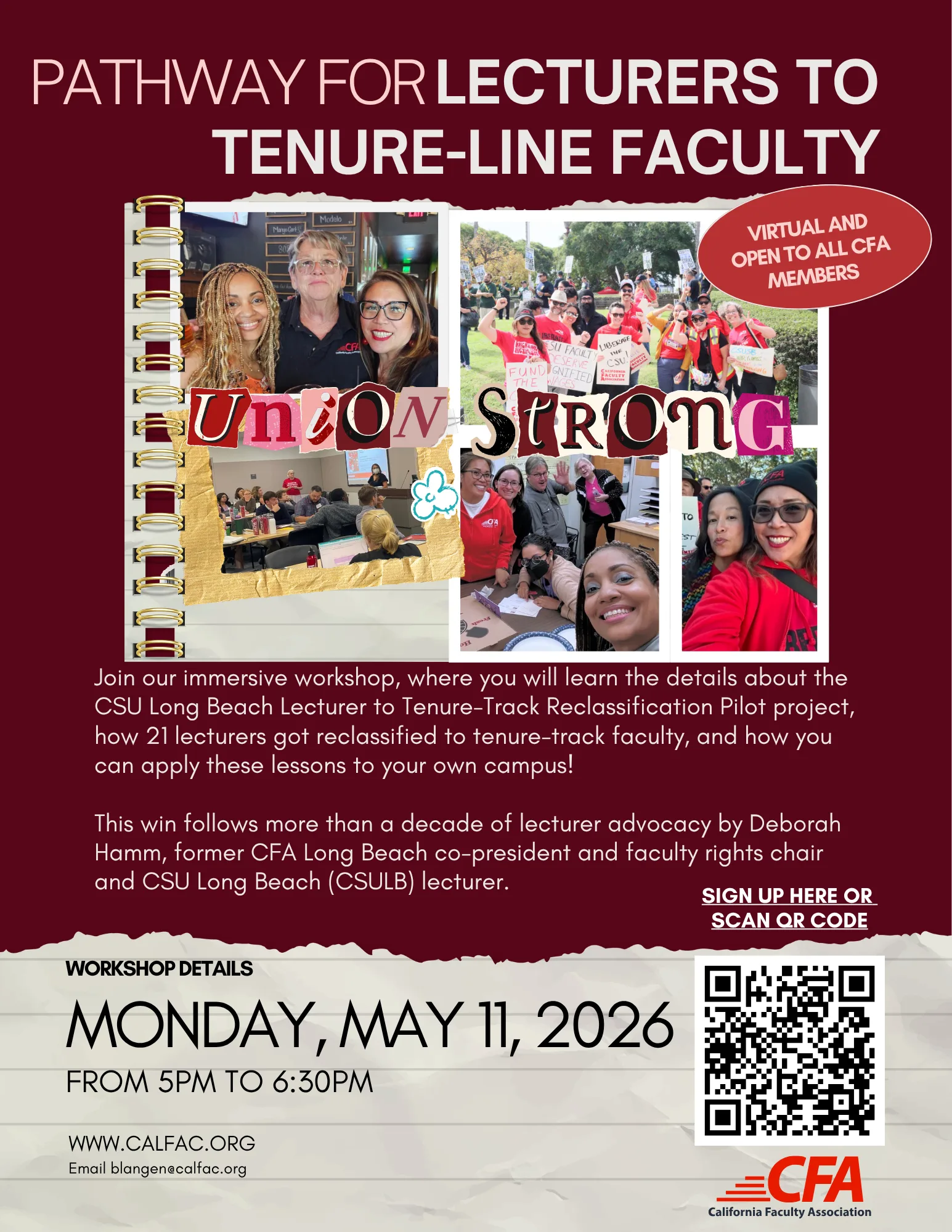
Want to learn more about CFA Long Beach’s pathway for lecturer to tenure-track?
Join the chapter’s interactive workshop where you will learn the details about the CSU Long Beach Lecturer to Tenure-Track Reclassification Pilot Project, including how 21 lecturers got reclassified to tenure-track faculty. We will strategize how you can apply these lessons to win this at your own campus!
Monday, May 11, 2026
5 p.m. – 6:30 p.m.
Register here. Please note that this workshop is only open to CFA members.
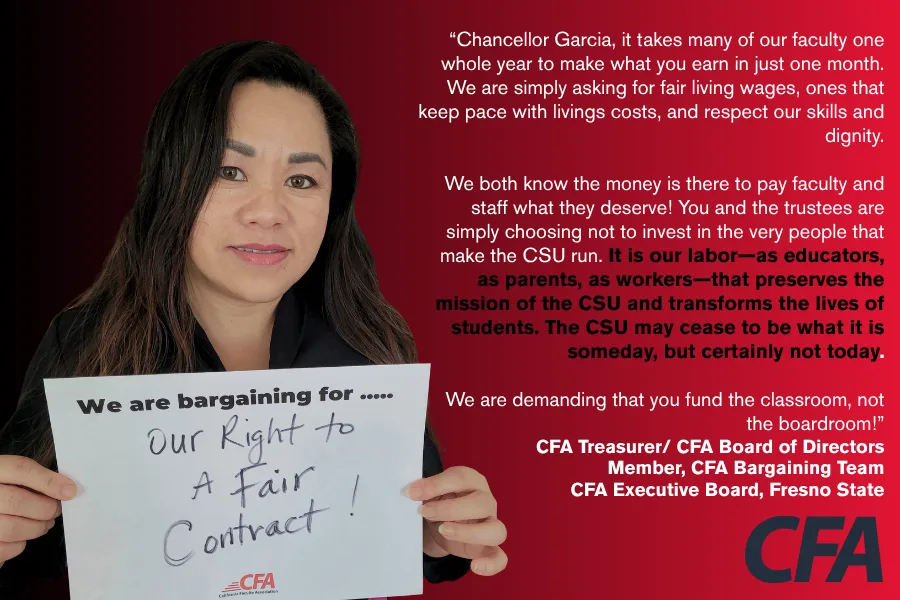
If you missed last week’s bargaining recap on salary, please click here to review what our CFA Bargaining Team has negotiated at the table.
This week, we want to break down our ten proposals on appointment. This is a substantial set of proposals that impact faculty on temporary contracts, especially lecturers. It also strives to improve counselor tenure density and the range elevation process.
Please note that these proposals may change as we continue bargaining at the table with management.
WHAT WE PROPOSED
1. Minimum Notice for Letters of Appointment
We proposed that official notice for appointments must be given at least four weeks prior to the start of the appointment.
2. Counselor Appointments
We proposed that counselor appointments require a recommendation to the president from the campus’ counselor committee—which is elected by counselor faculty.
3. Equal Pay Across Multiple Departments
We proposed that any faculty classified as “temporary” by the CSU, with appointments in multiple departments, should be assigned the same base salary and range for all departments, and that should reflect their highest base pay appointment.
4. Shorter Timeline to Three-Year Appointment
Faculty on temporary appointments currently require six consecutive years of service before they are offered a three-year appointment. We are proposing that we reduce that requirement to only four years of consecutive service before they reach their three-year contract.
As a side note, a consecutive year of service only requires that a faculty member teaches one semester during that academic year.
5. Three-Year Appointment Entitlement
Under the current contract, subsequent three-year entitlements are determined by the time-base held during the last year of the prior three-year appointment.
While this isn’t necessarily bad, faculty often find their time-base diminished in the last year of their contract for any number of reasons.
We are proposing that subsequent three-year and possibly longer term appointments should reflect the highest time base taught during the course of the prior appointment.
6. Clinical Professor, Clinical Faculty, and Teaching Professor Appointments
The CFA Bargaining Team was intrigued by a position that management proposed called “Clinical Professor,” whose primary assignment would consist of clinical instruction, supervision of internships, labs, or field-based professional training settings.
The team felt it would be necessary to expand the category to also include Clinical Faculty (whose primary assignment consists of psychological counseling) and Teaching Professor (whose primary assignment consists of teaching).
All three of these appointments would be full-time positions.
A Teaching Professor appointment helps provide a pathway to an ongoing appointment for lecturer faculty and allows applicants to be hired directly into that role. They are generally not expected to perform research and are not evaluated on their research productivity. This would allow if a faculty member on a temporary appointment completes at least six years of service in a three-year or five-year appointment with at least 0.8 time-base during the prior three academic years, they must be converted to a full-time continuing appointment at the beginning of the next academic year into this new Teaching Professor classification.
7. Easier Path to Reclassification
We have also proposed stronger language to create a more accessible pathway for faculty on temporary contracts to transition into tenure-track positions.
Instead of requiring an external offer of tenure-track employment, a colleague’s departmental peer review committee would now be able to review and recommend them for a tenure-track position.
8. Change in Order of Assignment
We are proposing substantial changes to the order of assignment to strengthen seniority rights and the process by which a faculty on a temporary appointment can become full-time. We will map out these changes in the next piece of our bargaining series.
9. Improving Range Elevation
We proposed that range elevation procedures shall also apply to counselors on temporary appointments who are eligible for reclassification.
Range elevation and reclassification will trigger under three conditions:
- When faculty on temporary appointments are evaluated for their initial three-year appointment
- When faculty on temporary appointments are evaluated for their status as a long-term faculty
- When it has been at least 5 years since their most recent range elevation.
This new range elevation eligibility would do away with the need to have at least six years of full-time adjusted service and it would streamline the process, making it easier for faculty to be eligible for range elevation and making that eligibility come more quickly.
10. Counselor Tenure Density
Finally, we proposed that each campus must have a minimum of 50% of its counselor faculty be appointed into either tenured or probationary appointments.
REJECTIONS ABOUND: WHAT MANAGEMENT COUNTER-PROPOSED!
The CSU bargaining team rejected nearly every CFA proposal listed above and included nonsensical modifications to a few of them.
While rejecting our proposal for a long-term faculty position, they instead proposed a five-year appointment for lecturer faculty that requires approval by the appropriate administrator and a questionable and subjective “exceptional” evaluation. This would mean that deans could gift a special five-year appointment to their favorite few, while denying it for the vast majority of lecturer faculty.
Management also changed the order of work assignment to include a “scholar/artist in residence,” which would replace the visiting faculty classification. Campus administrators would be in a position to renew, extend, or repeat this scholar’s appointment for as long as they wanted without any input from faculty. They would also receive work ahead of most lecturers in the order of assignment.
Lastly, management wants to exclude retired annuitants (i.e., faculty who have officially retired but wish to return on a limited basis) from academic year entitlement rights.
Besides these modifications and counterproposals, the CSU bargaining team has rejected every CFA proposal, and their counterproposals do little to address the precarity that so many of our faculty face.
Our proposals have the power to improve the stability and working conditions of our faculty, and we will not let management undermine the real transformation we help create on our campuses and in our students’ lives.
In the next part of our series, we will continue our discussion on appointment by breaking down our proposal for preference of work and order of assignment.
Please stay tuned and connect with your chapter as we strategize ways to fight for what we deserve!
Last week, students at many CSU campuses held actions to protest the CSU’s investments in war, in AI, and on the CSU Northridge campus, to protest against the racist criminalization of students of color by campus police. Faculty, staff and students admirably worked together at CSUN so that the student rally would be police-free. Faculty and students trained in de-escalation, together with the Harmony Keepers, student affairs professionals, and other volunteers, who were on duty to maintain safety, showing us all that there are police-free and weapons-free ways to nurture public safety on our campuses. As our campuses are filled with engaged students who dream of a liberated and socially just People’s University, it is important that faculty know our rights as unionized workers and as members of our campus communities.
In addition to the preamble of our 2022-2025 Collective Bargaining Agreement (CBA) which guarantees our academic freedom, faculty enjoy additional protections specifically relating to our interactions with campus police.
In our last round of bargaining, CFA secured language in the CBA which begins to limit police power on our campuses. This language exists in Article 37, Health and Safety precisely because CFA recognizes police presence on our campuses as a potential threat to the health and safety of communities of color, queer and trans people, and women/femmes.
As a unionized faculty member, you have the right to refuse to talk to campus police. Article 37.10 secures this right for us, and reads as follows:
37.10 All people have constitutional rights when it comes to interactions with police officers. CSU employees have those same rights when it comes to interactions with University Police. When University Police seek to interview a CFA represented employee, the employee has no obligation to participate. If, however, the employee chooses to participate, the employee may request to be accompanied by a union representative. If the request for a union representative is denied, the employee has no obligation to participate. Nothing in this provision shall limit the rights of employees to be represented by an attorney when interacting with University Police.
If, for example, you find yourself on campus at a demonstration or teach-in, and campus police ask to speak with you, perhaps to find out who or what you know about the protest happening, or to inquire about a student they are targeting (as they have done at CSUN), you have no obligation to speak with police.
If you agree to speak with police, we urge you to request a union representative to be present.
Protect yourself and each other, and be aware of your Article 37.10 rights to not speak with campus cops!
Want to learn more? Become active with your local CFA chapter Faculty Rights team. Find your representative here.
Browse the faculty contract here.
See an archive of Faculty Rights Tips.
If you have questions about a faculty rights tip or would like to suggest a tip, please write us with the subject line “Faculty Rights Tip.”

Ninety years after its founding in 1935, the Liberal Studies program at San Francisco State (SFSU) is slated for discontinuation. Aggressive downsizing and program discontinuance is now playing out among numerous departments at San Francisco State. While tenured faculty may be reassigned to other departments, lecturer faculty, already cut to a skeleton crew, have little hope of keeping their jobs.
This instability provided the framework for last week’s Orange Week at SFSU, which included theater, art exhibits, films, talks, poetry slams, organizing workshops, a “bonfire of the humanities,” and a revival of the annual SFSU Human Rights Summit. The events provided faculty and students an opportunity to dramatize and organize against the CSU administration’s toxic mismanagement.
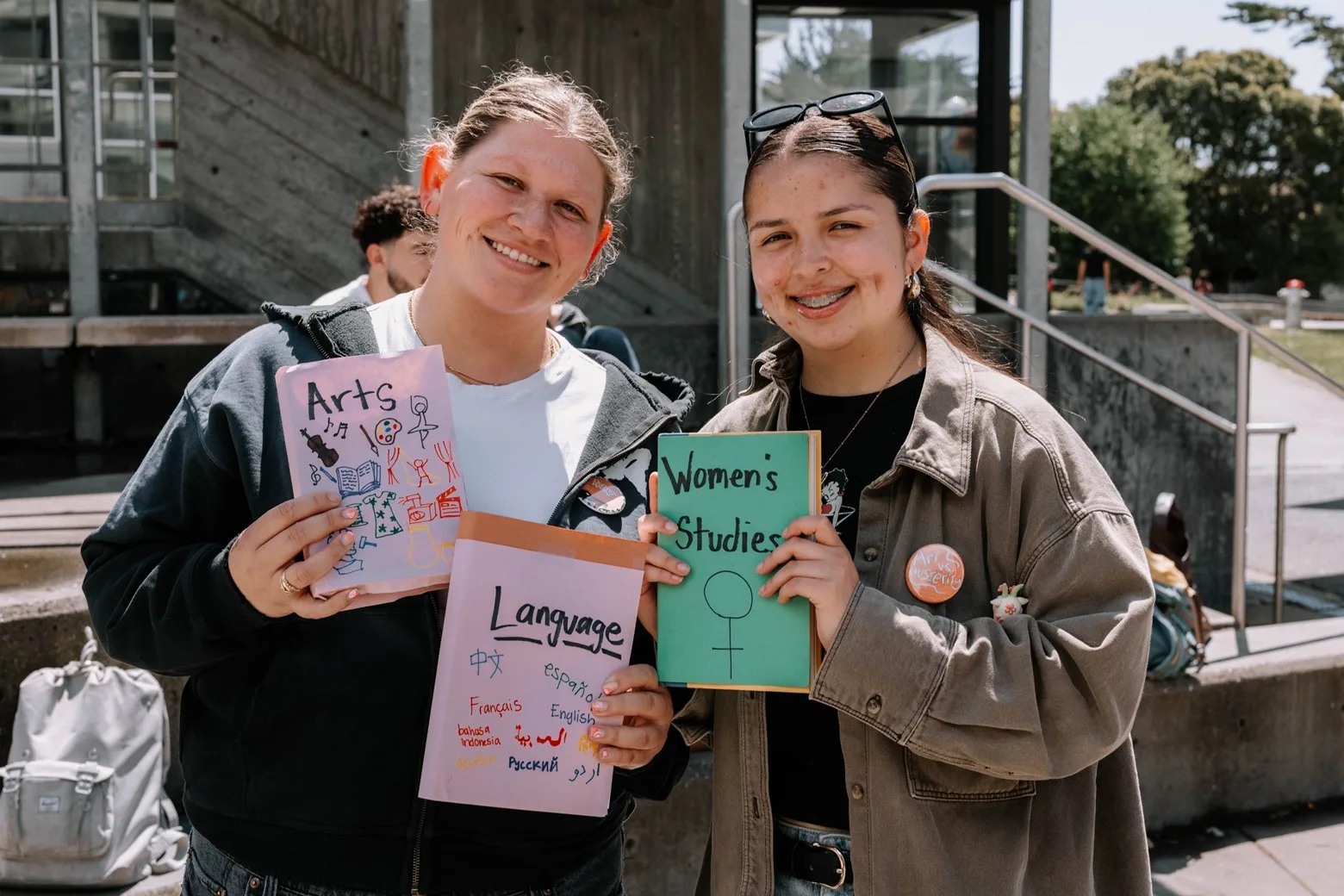
Orange Week draws its name from the “Orange Book,” a nickname for the pre-1993 CSU/state cost model. Its formal title was: The CSU Budget Formulas and Standards Manual.
Students and faculty passed out an orange booklet explaining that the manual’s framework was abandoned in the 1990s, freeing chancellors and campus presidents from their former accountability in how they spent public money, leading to a precipitous drop in the percentage of the CSU budget dedicated to instruction: from 53% in 1993 to 34% today. This neoliberal policy shift unleashed administrative bloat, growing class-sizes, unsafe counselor-to-student ratios, the adjunctification of faculty and financialization such that $13.2 billion has been siphoned from the classroom to cash reserves and speculative investments.
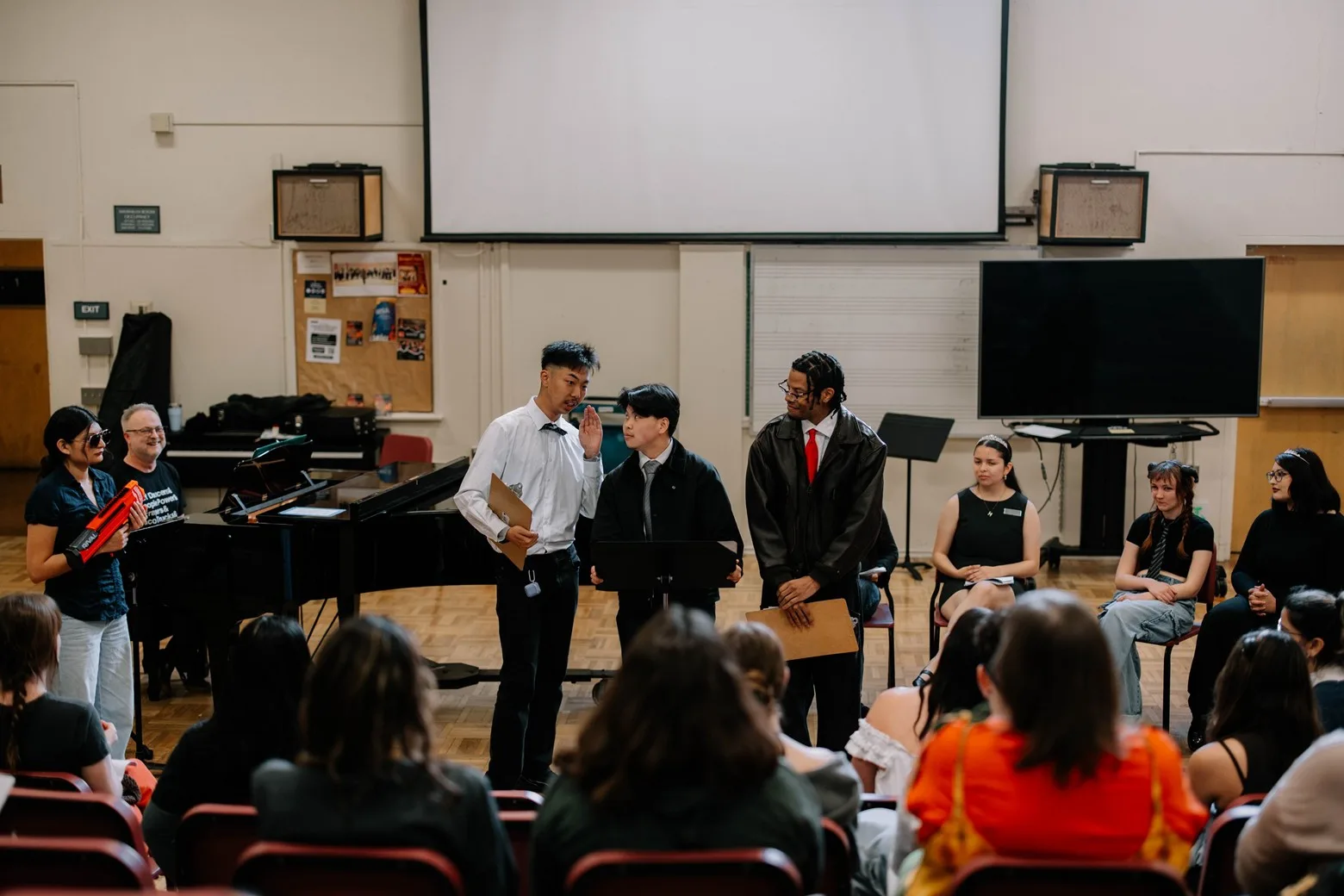
Inspired by Bertholt Brecht’s 1928 Threepenny Opera, Brad Erickson, CFA-SFSU president and faculty lecturer in Liberal Studies, wrote The Threepenny University, a musical play performed with his students during Orange Week. Like Brecht’s play, it offered a socialist critique of the capitalist world, while updating the setting to a CSU beset by turbocharged financialization and assaults on academic freedom and shared governance. The criminals, capitalists and lumpenproletariat of the Threepenny Opera are reincarnated as CSU administrators like Chancellor Millie the Moocher, Dean of Deans JJ Teachum, Campus Conduct Compliance Officer TP Emsworth, President Krampus, Provost Polly and their victims: debt-saddled students and overworked, ultraprecarious or unhoused former faculty.
The play opens at a lavish holiday party held in Chancellor García’s palace. There, administrators shower García with praise for her leadership remaking the CSU as a capital investment firm. JJ Teachum and his AVPs, Chad and Tad, sing “You can rule”:
No more freedom of speech or shared governance
Unions gone—
See the faculty floundering rudderless
Students tamed—
All those debt-saddled saps paying through the nose
So it goes, you’re so slick you can take every trick, you can rule!
Dollars flow—
Siphoned off from the classroom in mass amounts
Your trustees—
Fuel the privatization overhaul
By degrees—
We’re no longer expected to teach at all
Asset growth—
Is the wind in our sail, our holy grail
This is your sacred quest: take it all and invest! You can rule!
In the second act, besieged and struggling faculty and students despair:
We can’t afford to imagine what liberation could be.
Curiosity’s gone, and compassion? There’s a hole where that used to be.
We’ve lowered our low expectations.
From crisis to crisis we crawl.
We can’t afford to imagine, at all…
Erickson’s play portrays the chancellor’s path to total domination paved by hopeless, disengaged faculty in order to dramatize the urgent need for organized, collective action.
“When university workers are checked out and indifferent to their unions, we all become vulnerable,” said Erickson. “Many faculty don’t see themselves as workers but as professionals, yet in essence we are the same as any other worker. To think otherwise is an illusion, because we don’t own or control our means of production; management does. As individuals we can only respond from a place of weakness, but we are stronger together.”
Erickson revived the Human Rights Summit to honor his friend and mentor, Mariana Ferreira, an SFSU professor who passed away last summer. Ferreira, who had led the summit for ten years, was also the creator of the course “Performance & Pedagogy of the Oppressed for Educators,” a course fusing revolutionary theory to embodied practice that Erickson now teaches. He said, “by performing a play that explicitly addresses conditions faced by performers and audience, we enact Boal’s Theater of the Oppressed and Brecht’s Lehrstücke, participatory learning that collapses the separation of theory and practice, teacher and learner, performer and audience.”
“While every Human Rights Summit focused on organizing, it also incorporated the arts, not as a less important distraction, but as a way to pinpoint human experience and intensify the stakes of human rights,” said Erickson. “I thought of Mariana while we were on stage: students singing and hamming it up, audience laughing or jeering the Chancellor character. When our popcorn machine set off the fire alarm, we continued the third act outside with everyone crowded into a pathway, audience and actors mixed together in concentrated, joyous resistance.”
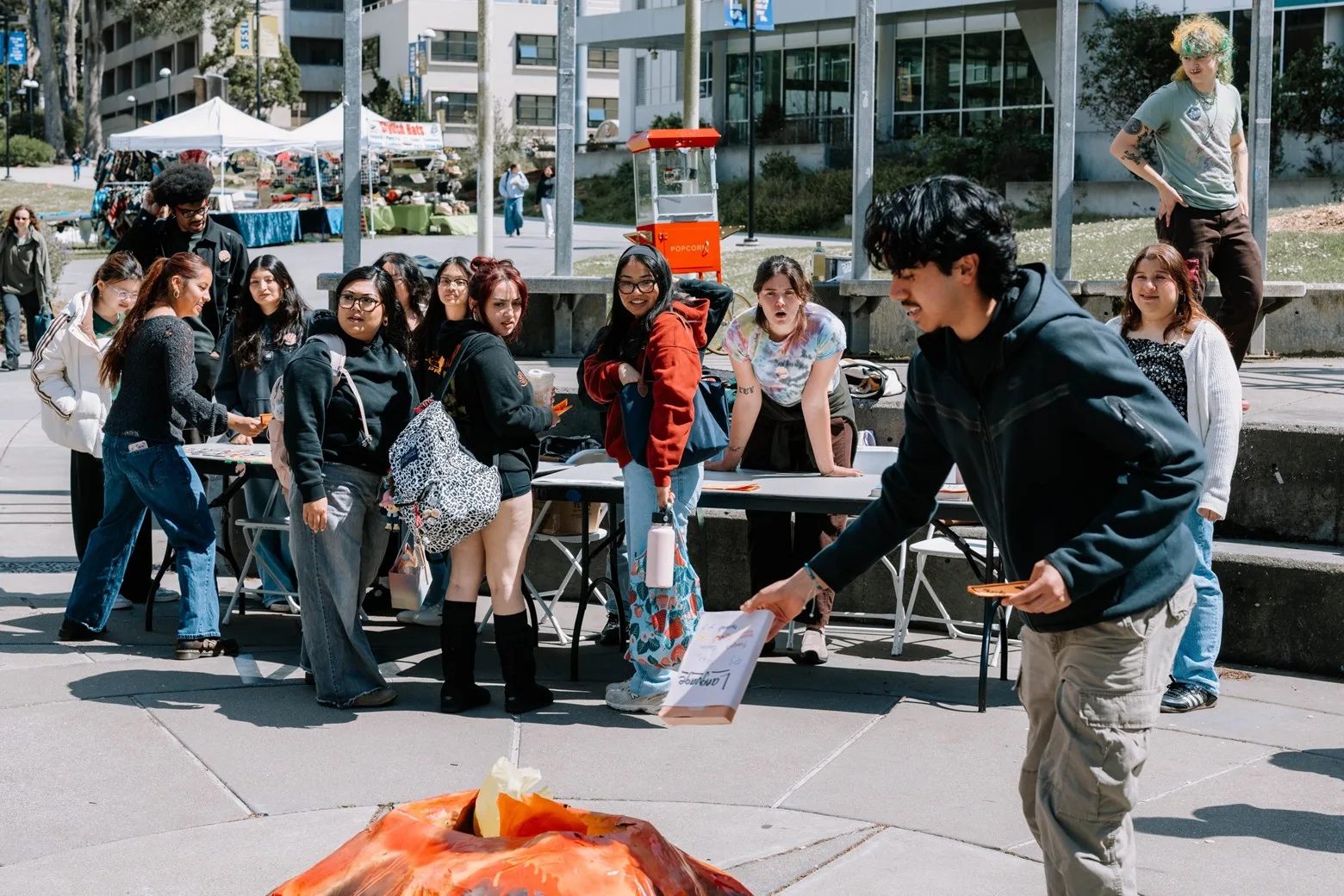
Nicole Banducci, a third-year Liberal Studies student at SF State, shared her concerns about the program’s future closure and why these art activities matter. She helped organize the “bonfire of the humanities” activity, in which passersby would throw books labelled with the names of discontinued liberal arts programs at SF State into a giant volcano, dramatizing the broader assault on humanities in public higher education.
“CSU administrators are removing a lot of money from the classrooms and putting them into AI programs and non-operational investments,” said Banducci. “I didn’t know ITEP (the Integrated Teacher Education Program) and the Liberal Studies program were being cut until after I started the programs. We are bringing awareness to this because it is a big deal, and our event shows other students what we are missing out on. It is affecting us and pushing people away from SF State.”
As Erickson explains, over 615 faculty lost their jobs at SFSU in just the past two years, and he may soon lose his as well. With emotion in his voice, he explained his affinity for his current department. “I’ve taught in eight departments at five universities, with three of those departments at SF State. I’ve only been in Liberal Studies since 2015, but with respect to my students and my coworkers, and the way I’ve been able to integrate teaching and research and organizing, it’s been the best place I’ve ever worked.”
Suzanne Pullens, a CFA San Francisco member and SFSU lecturer faculty, attended the play and described to students afterward just how little faculty get paid and how serious the impacts of the cuts are. She stated that the number of lecturer faculty in her Department of Communications Studies has gone from 47 to just four since the pandemic.
“Chancellor García’s $80,000 of deferred payment would pay for my entire salary,” she said. “That’s how much I get paid here with a PhD and 11 years of teaching experience. When you think of the dedication of the faculty who are staying here, it’s because we love being here… but we can’t afford to love being here much longer.”
Erickson explained that SFSU administrators tried to justify the program discontinuances by claiming that SFSU has too many majors compared to other campuses, and that it was necessary to consolidate. He pushed back against flattening the diversity of CSU campus offerings.
“The CSU is great because it offers so many different concentrations,” said Erickson. “For example, SF State is the birthplace of Ethnic Studies, and it has very strong arts programs. Many unique and distinct programs are being erased through cuts and program discontinuances, and it’s being done without shared governance. And they haven’t demonstrated financial or pedagogical benefits.”
The last cohort of Liberal Studies students will be admitted in the fall, and Erickson will teach out the remainder of the students before his employment evaporates. He encouraged both tenured and contingent faculty to consider the shaky ground we tread on.
“Tenured faculty may feel more secure in their freedoms and agency because they’ve generally been able to teach, research, and publish as they like, with institutional support,” said Erickson. “But, at SF State, it’s becoming increasingly obvious that none of this can be taken for granted. They’re having to wake up to the lack of agency that most lecturer faculty have experienced all along, given our precarity, lack of equity in pay and workload and normative exclusion from shared decision-making.”
Rather than admit defeat, however, Erickson urges unity.
“This is an opportunity to build solidarity, to build shared consciousness as workers under capitalism,” he stated. “It doesn’t mean we’re all going to agree on everything, but we still need to fight for each other. I have to have solidarity with my tenure-line colleagues, just as they need to have it with me, because we are all in the same union. It’s going to take a lot of work, a lot of door-knocking, one-on-one conversations, and we have to do it without leaving anyone behind.”
For Erickson, his play wasn’t just a way to demonstrate the relationship between the arts and social change, but a way to lampoon the chancellor and management’s destructive behavior and to highlight the perseverance and resistance of faculty and students acting collectively.
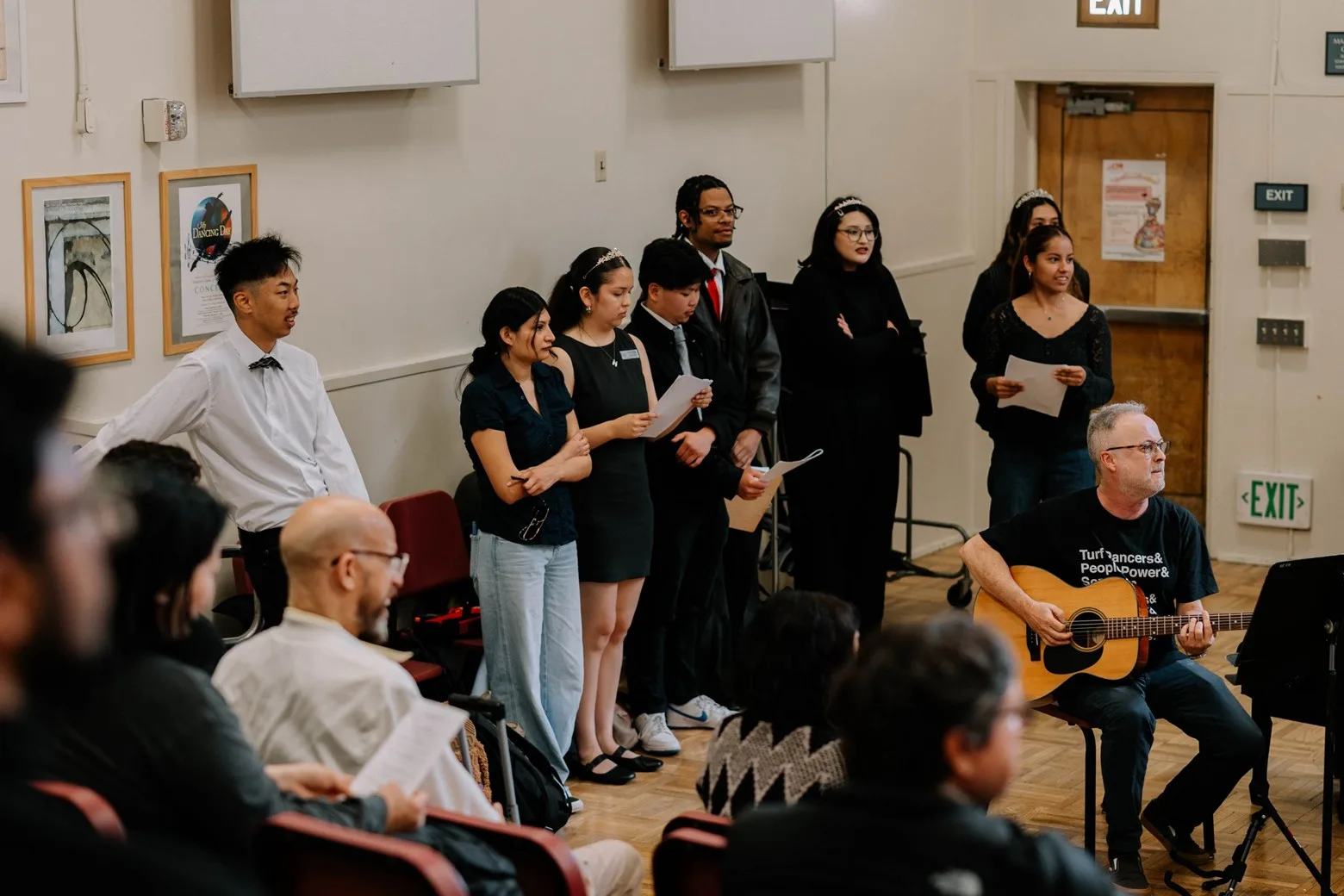
Throughout its three acts of carnivalesque laughter and reversals, the audience moves from a world in which administrators hold the power to one in which faculty and students take back that power.
The final act models an aspiration of what the university could look like should we take charge, and what could happen, as Erickson puts it, “when we organize from the bottom but strike at the top.”
“Millie tried to fool us all. She’s now in the detention hall.
Our campus is tuition-free!
The people’s university!
ICE is banished, except in drinks; Millie’s chilling in the clink.
We fought back their austerity.
The people’s university!
TPM has been demolished; student debt has been abolished.
No two-tier system; speech is free.
The people’s university!
The people’s university!
With bottom-up democracy.
We took away their power, YOINK!
Bye, bye, Millie, OINK, OINK, OINK!”
Following our series on members of the CSU Board of Trustees, CFA is profiling current and former CSU executives. You can find Part 1 here.
California State University campus presidents are officially titled “chief executive officers (CEOs),” according to the CSU administration’s own terminology. A CEO is the highest-ranking operational leader in a company, and what we see through Chancellor García’s vision for the CSU is a Fortune 500 company, not a public university. CEO’s also represent the public faces of their campuses and function as the primary liaison between the universities and the campus plus the broader community. They report to the CSU chancellor and work closely with the CSU’s systemwide office.
CFA chapters have different relationships with their campus presidents, so we don’t want to suggest they’re all the same. However, as the CEOs of the campuses, CFA chapters similarly call on them to work with us as partners, and sometimes call on them in struggle, as we organize faculty, staff, and students to push for policies that support the best learning environment for students.
Just as we’ve highlighted Board of Trustees’ members, we now move on to CSU executives, including campus presidents/CEOs as well as at the records of other CSU executives, like a former campus chief financial officer (CFO). Distinct from campus CEOs, campus CFOs oversee and direct the short and long-term financial goals of CSU campuses. CFA members recognize the power and privilege that comes with the CFO position and call on them to partner with CFA in improving the learning and working conditions on our campuses.
Here’s information you should know about a few current CSU executives. We want faculty to pay attention to executives’ actions, inactions, and messaging because it affects our working conditions and student learning conditions.

Erika Beck, President/CEO of CSU Northridge
Beck has been the campus president since 2021. Her annual base salary is $563,012, or $46,917 per month. She also receives an annual housing stipend of $60,000 and $12,000 a year in car allowances.
Before she began serving as the president of CSU Northridge (CSUN), she was the president of CSU Channel Islands from 2016 to 2021. She was also provost and Executive Vice President at Nevada State College from 2010 to 2016.
She has a B.A. in Psychology and Ph.D. in Experimental Psychology from UC San Diego and a M.A. in Psychology from San Diego State.
CFA Northridge members are disappointed in Beck’s lack of response to demands related to CSUN police’s aggressive tactics against students, many of whom are Black. Campus police have arrested six students during the 2025-26 academic year, and two of these students have pending felony charges.
Hands Off Students, a coalition of students, faculty, staff, and community members, called at CSUN, called on Beck to respond to an open letter of demands, including the abolition of campus police, the dismissal of charges resulting from campus policing actions, the termination of campus police who used excessive force, the disclosure of all policies on police surveillance on campus, and the establishment of regular community police accountability forums.
Hundreds of community members have also signed a petition urging Beck to take action. As of publication of this piece, Beck has not taken any action.
Faculty should be able to expect more from Beck, given that she has shown support for students in the past. In 2024, she helped posthumously expunge the record of Dr. William Burwell, who was arrested during a protest for racial equity known as “Storm at Valley State” at CSUN in 1969.
It’s also worth noting that Beck has ties to the Los Angeles business community. She is a board member of the Los Angeles Chamber of Commerce and the Executive Committee of the Los Angeles County Economic Development Committee’s Board of Governors, according to her profile on the CSUN website.
Britt Rios-Ellis, President/CEO of Stanislaus State
Rios-Ellis has been the campus president since 2024. Her annual base salary is $370,319, or $30,859 per month. She also receives an annual housing stipend of $60,000 and $12,000 a year in car allowances.
Before she began serving as Stanislaus State’s president, Rios-Ellis was the provost and executive vice president of Academic Affairs at Oakland University, a public university in Michigan. Prior to that, she was dean of the College of Health Sciences and Human Services at CSU Monterey Bay from 2014 to 2020. And from 1994 to 2014, Rios-Ellis was faculty in the Department of Health Science at CSU Long Beach.
Rios-Ellis has a B.A. in Political Science, B.A. in Spanish, M.S. in Health and Fitness Management, and Ph.D. in Community Health from the University of Oregon.
Her speeches focusing on cariño, which she defined as a value and a practice reflecting love and justice in action, have raised eyebrows.
“Leading with cariño means that we have our students’ well-being and future at the center of our intention at all times,” Rios-Ellis said during a Fall Welcome Address in August 2025. “I want you to know that it is with cariño that I pledge to lead Stan State.”
Stanislaus CFA members know that underneath that message, Rios-Ellis is conveying her mistaken belief that cariño for students should come at the expense of cariño for faculty and staff. In reality, faculty working conditions are student learning conditions.
Notably, Rios-Ellis doubled down on cariño in a recent Forbes profile. She didn’t lead with cariño when a former dean at Stanislaus State wrote her a resignation letter in summer 2025 after facing racial discrimination and harassment, however. The former dean of the college of business administration wrote that he faced race-based public disparagement, social media slurs, racist hostility, and public humiliation, according to The Fresno Bee.
Investigating and responding appropriately to racist discrimination is our collective responsibility, but campus leaders have a legal responsibility to make sure that the workplace is free from this kind of behavior.
Berenecea Johnson Eanes, President/CEO of CSU Los Angeles
Eanes has been the campus president since 2023. Her annual base salary is $521,024, or $43,419 per month. She also receives an annual housing stipend of $80,000 and $12,000 a year in car allowances.
Before she began serving as president of CSU Los Angeles (CSULA), Eanes was president of York College, City University of New York (CUNY). Prior to that, from 2012 to 2019, Eanes was vice president for Student Affairs at CSU Fullerton.
She has a B.A. in Public Health from Dillard University, a M.A. in Social Work from Boston University, and a Ph.D. in Social Work from Clark Atlanta University.
Eanes was an unpopular leader at her most recent job, as detailed in this 2023 New York Daily News opinion piece titled “York College CUNY is Killing the American Dream.” Around the time she was hired at York College with a $320,000 annual salary, CUNY laid off 2,800 lecturers, according to the World Socialist Web Site, demonstrating she has a history in caring more about her own salary over faculty jobs.
When she was hired at CSULA, her administration imposed a hiring chill. Then in 2025, Eanes imposed a hiring freeze. Despite the chill and freeze, she added a second provost, senior vice provost, and other admin-level positions.
Additionally, CFA Los Angeles has recorded nearly 20% budget cuts to instruction since Eanes began. The chapter believes they have lost a couple hundred lecturers under her leadership. Meanwhile, she spends money on convocations and celebrations without faculty input.
Eanes has also attacked shared governance and rejected academic freedom policies that have gone through faculty policy committees and the campus Academic Senate.
She promised to create a strategic plan and claims that because the campus doesn’t currently have one, she can’t begin to make needed campus improvements that support the safety and learning of CSULA students. For example, King Hall is an instructional building with many structural issues posing serious health and safety risks (exposure to asbestos, mold, and lead paint), which the campus has known about for twenty years.
In her administration’s strategic planning meetings, complaints are made about the condition of facilities and that the library’s pest problem isn’t being addressed. But these are placed as burdens of the people who work in the buildings rather than prioritizing university money to pay staff to attend to these issues.
Cathy Sandeen, President/CEO of CSU East Bay
Sandeen has been the campus president since 2020. Her annual base salary is $458,134, or $38,178 per month. She also receives an annual housing stipend of $60,000 and $12,000 a year in car allowances.
Before she began serving as president of CSU East Bay, Sandeen was chancellor of the University of Alaska Anchorage and chancellor of the University of Wisconsin Colleges and University of Wisconsin-Extension. She also worked as faculty at San José State and San Francisco State in the past.
Sandeen has a B.A. in Speech Pathology from Cal Poly Humboldt, a M.A. in Broadcast Communication from San Francisco State, a M.A. in Business Administration from UCLA, and a Ph.D. in Communication from University of Utah.
As chancellor of the University of Wisconsin Colleges, Sandeen faced a no-confidence vote after just six months on the job. Faculty criticized how she made budget cuts disproportionately affecting instruction compared to administrative positions, according to the Post Crescent.
At CSU East Bay, Sandeen has repeatedly ignored shared governance. Faculty also say she has cut dozens of course offerings, while also reducing the university’s reserves. Meanwhile, she gave management a 5% raise when we won our last CFA contract.
Sandeen has additionally preferred a mass marketing campaign over targeted marketing to increase enrollment. This includes dropping GPA requirements and offering small scholarships which might result in a small temporary bump, but it’s ultimately not sustainable. She also decided to unnecessarily rebrand the entire university, which involves a huge expense. This was decided in the midst of a budgetary crisis.”
Under her leadership, CSU East Bay received a concerning Notice of Concern from the Western Association of Schools and Colleges (WASC) Senior College and University Commission (WSCUC), the regional accrediting agency of public and private universities. WSCUC is scheduled to conduct a special visit in 2027 to review the university’s progress.
Separately, CSU East Bay also lost its College of Education and Allied Studies when Sandeen decided that its departments should be reorganized into other colleges.
Recently, Sandeen tried to eliminate the Spanish Bachelor of Arts program, but was met with significant backlash from the campus and local communities as well as legislators. You can read more about it here.
Outside of the CSU, Sandeen is a senior adviser to an educational technology venture capital firm, New Markets Venture Partners (NMVP). One of their portfolio companies, Motimatic, offers student retention services and enrollment advertising, and was awarded two contracts by CSUEB between 2022 and 2025, totaling nearly $160,000. NMVP is also strategic partners with the ECMC Foundation, a nonprofit with CSU ties that fights student debtors who try to file for bankruptcy.
Join California Faculty Association
Join thousands of instructional faculty, librarians, counselors, and coaches to protect academic freedom, faculty rights, safe workplaces, higher education, student learning, and fight for racial and social justice.